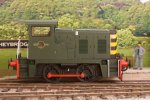
Heljan BR class 02, conversion to S7

RichardG

Western Thunderer
CV54=0, F1 is useful but find I still manually fine tune the decoder afterwards. I now start by using the recommended motor control settings suggested by ESU, see which one gives the best performance then manually fine tune from there. I've found you can use CV54 several times on the same decoder and get different motor parameter settings each time.

In the instruction book for the decoder there is a table ("Load regulation table for commonly used motors") giving all 12 parameters for 15 different motors, so 180 numerical values. So I do wonder if ESU use CV54=0, F1 themselves.

I suppose the amount of tweaking we do depends on how much of a perfectionist we are, and how easily we can sense small changes. I adopted the Lenz 'Standard V2' for many of my H0 locos, and here you get six pre-defined profiles for different motors. So you choose the profile which works best, and stop worrying.

The LokProgrammer does look very good, but I have decoders from numerous manufacturers. So I see CV54=0, F1 as a fair compromise, and very convenient too.
 
Last edited:
RichardG

Western Thunderer
DSC_2989.jpeg

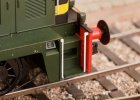
The new handrails are of nickel silver wire (diameter to match the brass wire handrails on the model) with top brackets drilled and cut from 1 mm square styrene . . .

DSC_3108.jpeg
I have installed the new handrails, these are glued into holes drilled through the bottom steps.

Heljan have put the LEDs for the running lights inside the buffer beam, with light pipes taking the light to the scale-size lamps. The new handrails bridge the join between buffer beam and chassis, and prevent me from removing the buffer beam from the model.

In practice, the buffer beam is so thin that the light from the LEDs shines through it. I only discovered this with DCC. Realistically, if a LED fails I doubt I will want to renew it, so I think this change is worthwhile.

DSC_3107.jpeg
All of the handrails now match up with each other, except for the moulded plastic one on the verandah.

But now, the conversion to S7 is now causing me a fresh problem I never envisaged: I don't want to do it.

I have a clear plan of how to do the conversion, mostly due to the help from contributors to this thread. I have gathered up the new wheels and a gear, and some glass fibre rod to make the new axles into split axles (thanks @simond). But if I do the conversion, the model will sit in a cupboard most of the time until I build a layout for it. I feel a bit embarrassed, but truly this is not for any lack of gratitude. If I end up putting the Slater's wheels onto 32mm axles please forgive me!
 

simond

Western Thunderer
Richard,

there is no point in taking a functional model to bits if your heart is not in the end result.

I would keep the S7 conversion until you have a layout needing it (or at least are en route to same) - put the bits in a (labelled!) envelope at the back of the "one day" drawer.

best
Simon
 

76043

Western Thunderer
Richard,
I thought your test track is a combined FS7 / S7? So why not run it as it is a FS loco on the layout and build some BR period wagons? (You would only need one mineral and a brake van) I know the layout is set much earlier but often the running boards never changed until closure.
Tony
 

Yorkshire Dave

Western Thunderer
I have a clear plan of how to do the conversion, mostly due to the help from contributors to this thread. I have gathered up the new wheels and a gear, and some glass fibre rod to make the new axles into split axles (thanks @simond). But if I do the conversion, the model will sit in a cupboard most of the time until I build a layout for it. I feel a bit embarrassed, but truly this is not for any lack of gratitude. If I end up putting the Slater's wheels onto 32mm axles please forgive me!

I wouldn't worry about it - as @simond has noted, just do the conversion when the mood takes you. You'll probably end up making up both sets of axles for FS and S7 in an idle moment. The other thing you would have to do is short the wheel rim to the brass centre boss.

Quite often I've sat at the workbench with the aim of working on a particular model, lost interest and ended up faffing around with something else for a completely different model irrespective of scale. I've lost count of the number of rail and bus models I have on the go in various stages of construction or conversion.
 

RichardG

Western Thunderer
I thought your test track is a combined FS7 / S7? So why not run it as it is a FS loco on the layout and build some BR period wagons? (You would only need one mineral and a brake van) I know the layout is set much earlier but often the running boards never changed until closure.

"Heybridge Basin" is a mixture of 32 and 31.5 mm gauges. It runs models with finescale wheels, and also models with S7 wheels if they are gauged accordingly. The models with finescale wheels will run on S7 plain track, but of course not through pointwork; and my models with S7 wheels gauged for 31.5 have a good chance of falling down between 33 mm gauge rails!

But staying with FS, this is a perfectly valid idea, and it would give me access to a much wider selection of wagon kits. If I lift out the model figures in their period dress, the layout passes well for much more recent times.

I could even imagine the line re-opened during the Second World War, restoring the (fictional) rail connection from Heybridge Basin to Witham. This would provide an excuse to buy one of those Chrezo S100s! Indeed, the line could have then continued to operate as a freight-only operation into the late 1960s or 70s, surviving the line from Langford to Maldon and finally closing when the timber viaducts at Wickham Bishops were declared unsafe. It would probably be taking things too far to follow this with a tourist line based at Langford, just across the road from the present-day Museum of Power, but I have enough British H0 stock to develop this theme :))

When you have accepted a might-have-been, it is terribly easy to extend the idea forwards. It might be wiser to accept the closure of the line before WW1, to put a boundary on things.
 

spikey faz

Western Thunderer
Richard, I suppose it depends on whether you'd get more satisfaction from the building or running of said locomotive, or both.

My Crosti 9f is far too big to run on my current bit of track, but I had a lot of fun building it.

Mike
 

mickoo

Western Thunderer
CV54=0, F1 is useful but find I still manually fine tune the decoder afterwards. I now start by using the recommended motor control settings suggested by ESU, see which one gives the best performance then manually fine tune from there. I've found you can use CV54 several times on the same decoder and get different motor parameter settings each time.
I gave up on CV54 because as you note, the results are variable each time you do it. Whilst it writes the new values to the chip it does not write them to your project in your software. If you don't read back from the the chip after doing a CV54 then your laptop or PC does not tally, so the next time you make a change on your project and upload to the chip you just go and undo all the CV54 set up did for you.
 

RichardG

Western Thunderer
Richard, I suppose it depends on whether you'd get more satisfaction from the building or running of said locomotive, or both.

My Crosti 9f is far too big to run on my current bit of track, but I had a lot of fun building it.

I need to get myself into a mindset in which I accept I am building a showcase model, where the running is sporadic but enjoyed with friends.

This was easy enough for the class 45/0 because it could not and cannot run on any layout I have room to build. The 02 is harder because it fits so well onto my FS layout. It is like having a new model railway. All I need to do, as @simond suggests, is to put the new parts in a safe place (done) and just enjoy it as it is for a while.
 
Top