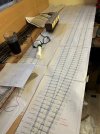
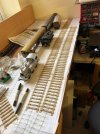
Hayfields new layout, 3D printed test track to something a bit bigger

Hayfield1

Western Thunderer
For those who read my postings you will know I am enjoying a journey in 3D printed track
362.jpeg

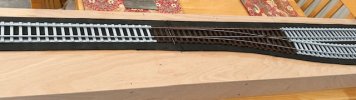
As some have read I wanted test track which I could also use to promote 3D track

366.jpeg

To that end I made a simple short test/demonstration track, which I painted. the track hopefully disguising its origins

448.jpeg

Then added some scenic features, which I enjoyed building. Took it with me to a couple of shows. However the (working) 3D printer was and still is the star and it seemed certainly within the 7mm scale circles there was little or no resistance to the idea of 3D track. In fact it was what 3D trackwork could give them that either RTR trackwork could not or lack of scratch building skills prevented them from getting what they desired.

Well for over a year I decided to utilize two base boards I have with an EM gauge project on, this has stalled for 3 to 4 years, so I made a start in removing the track and scenic items I had built up.
1760530228828.png

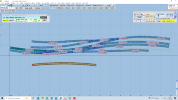
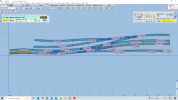
This is the plan I had started to develop and I thought I would tidy it up a bit, unfortunately I made it too long. Its based on a very successful idea/layout on here called Stroudly Park, by SouthernFan Ian of this parish.

Perhaps a little bit of Minories is some aspects, but not a layout designed for running sessions or long trains, a setting to keep and run items. In tidying up I made it 2' too long (too long between sessions (5 months) and I may still alter the design as I go on

As i said the idea is simply a scenic layout to run and store my stock in my workroom. No fiddle yard and a very much shortened platform area, It will have the ability to grow if space becomes available. I have 14' 6" in length to play with. Also its somewhere I can indulge myself in a bit of scenic work, and run the odd loco or train plus store my stock in view

1.jpeg I quickly realised my error of it being 2' too long

I am temporally using some space in sorting out one of my wife's friends model railway remnants which he wants to dispose of, so I need to get on and sell them
1760531351242.png

This is the revised plan for three 4' x 2' boards plus a 2'x 2' board at the left hand end. At the right hand end will be a 6" x 2' board which will be the end platform concourse and low relief station building.

The area top middle and left will be a storage area for stock, this needs a bit of thought. Carriage sidings/goods yard and or engine shed/storage area

The first step will be to print and build the track for platform 1. At the same time think about platforms.

Don't expect massive or even rapid progress, its been in my mind for over 2 years and just waiting for various thinks to happen which includes reducing my 4mm scale collection and some junk I have amassed. First tof all is to get on with selling my wife's friends 2mm scale oddments
 

martin_wynne

Western Thunderer
Simon you are quite correct and its something I may well do as all the crossings are 1-6 so RTR should work through them
@Hayfield1

Hi John,

Changing to 0-MF from GOG-F will cause the turnouts to become fractionally shorter, and you may need to redesign the track plan to suit.

However there is a way round this if the turnout has a regular-type V-crossing. Using the the SHIFT+F11 mouse action you can adjust the turnout lead length, until it is the same length as before:


adjust_lead_0_mf.png


But generally in Templot it is best to set the gauge/scale at the start, as you mean to go on.

cheers,

Martin.
 

Hayfield1

Western Thunderer
@Hayfield1

Hi John,

Changing to 0-MF from GOG-F will cause the turnouts to become fractionally shorter, and you may need to redesign the track plan to suit.

However there is a way round this if the turnout has a regular-type V-crossing. Using the the SHIFT+F11 mouse action you can adjust the turnout lead length, until it is the same length as before:


View attachment 249714


But generally in Templot it is best to set the gauge/scale at the start, as you mean to go on.

cheers,

Martin.

Martin

Thank you for the advice, looks like I better dp it sooner rather than later.

A big but is I have not finalised the design and I am very conscious that the trackwork at the baseboard ends aligns exactly with each other. To this end printing bricks (sections) will stop at the ends rather than overlap. Hopefully this will become clearer when printing commences

1760691226592.png

I have decided to add an extra line at the bottom for both an end loading ramp and a road to house the station pilot, plus it saves having to think up what to do with the space scenically

John
 

Hayfield1

Western Thunderer
2.jpeg

I have printed out the additional road and it certainly uses up some spare space. Not very clear in this shot is the end loading platform, at the moment its about 4" long. I have also converted this section to 0MF (for some reason Group gauge convert is not working).

I am not too worried about converting the track it in sections, firstly I have not finished adjusting the track design detail, example these pairs of track will be printed in 60' panels (in 30' sections to fit my print bed). Secondly as its in full view it needs the most detail, so will need fishplates etc

As I have done no real 3D printing since Stafford, my filament needs drying, which is the next job, followed by a a few STL printing files
Track bed decision is needed, I am still thinking of using C&L 5mm closed cell foam, any thoughts of other materials

I have also been thinking of platform construction, including signals, to that end I have just ordered a second hand copy of "A Pictorial Record of GW Signals for some inspiration and details (size & format of platform starters. I must get my head around how MSE 7mm scale signal kits/parts are sold.

Last of all I was going to build the next 4' x 2' baseboard, but now I think the 6" end board would be the best option.

Too much thinking and not enough doing

John
 

Hayfield1

Western Thunderer
My mind has been concentrating on the platform ends, especially regarding the signals

3.jpeg
I printed up most of the next base boards templates, simply so I can make a mock up of the platform end and starter signals

I then just overlaid them on on top/next to the previous board, simply to see how the templates fitted together and to get an overall idea of the station size,

A good result as I might just about get away with 3 bogie coaches into the platforms with a loco, which is better than expected.

4.jpeg

More or less the first baseboard

5.jpeg

Looking the other way, plans cover about 3/4 of the next board, most of the turnouts will be on this middle board

John
 

Hayfield1

Western Thunderer
8.jpeg


I have printed out the first two tracks, firstly they need to be made into their 60' panels and rails threaded through.
Next up will be to lay the track base

9.jpeg
Parts arrived to make the bracket signal

brac2 (1).jpg

Having been suggested the GWR did not use center post bracket signals (or was it not as station starters) I found this photo on the GWR Modeling site, I now need to study the platform in a bit more detail so that I can see how to chop up both the brackets and platform, plus but another set of platform and brackets

John
 

simond

Western Thunderer
I think the comment was that balanced brackets with same height dolls were not used as starters.

That interested me, so I had a quick look because it seemed like a logical arrangement to me but couldn’t find any. I haven’t done anything like a proper search, so have no reason to doubt the comment.


Simon
 

JimG

Western Thunderer
I think the comment was that balanced brackets with same height dolls were not used as starters.

That interested me, so I had a quick look because it seemed like a logical arrangement to me but couldn’t find any. I haven’t done anything like a proper search, so have no reason to doubt the comment.
Simon,

I don't know if you are only referring to the GWR or not, but try Glasgow Buchanan Street station. :)

View Of Class 5 Locomotive At... | Image | trove.scot

Jim.
 

Hayfield1

Western Thunderer
I think the comment was that balanced brackets with same height dolls were not used as starters.

That interested me, so I had a quick look because it seemed like a logical arrangement to me but couldn’t find any. I haven’t done anything like a proper search, so have no reason to doubt the comment.


Simon
Simon

I may well be signalling the platforms incorrectly. This signal is to control the end of an island (2 sided ) platform at a terminus (platforms 1 & 2), my thought is both lines have equal status so the signal arms should be the same height. Also a T bracket pust/bracket means the signal post is in the center of the platform

brac2 (1).jpg I have this photo (not at the end of the platform) showing the GWR uses T bracketed signals.

My layout is both factious and GWR/Southern

1761989793638.png

Perhaps someone could help with signalling advice please
The bottom road (22 PR279) is simply a siding with an end loading ramp
The next 2 roads (24 PL294 & 12PR247) are platforms 1 & 2
The fourth road (11 PL246) is platform 3 and at the moment a single sided platform
The top road is undecided and may be platform 5 or equally a headshunt for loco / carriage storage sidings. Undecided so ignore please

For the bottom siding I was going to have a single arm signal
Platform 1 & 2 a double arm bracket signal
Platform 3 a single arm bracket signal (signal pots against the platform fence), but may change if the layout design changes

All advice very welcome

John
 

simond

Western Thunderer
Hi John,

T brackets are/were not uncommon, but the dolls are different heights in your photo.

I think the issue is that the GW didn’t seem to have a lot of island platforms at termini, I had a look through one of my Clark, An Historical Survey of Selected Great Western Stations, Layouts & Illustrations books, and got to page 110 before I found Minehead, which is signalled thus

image.jpg
The lower platform face is referred to as “the bay” and thus has lower status than the upper, but both have individual posts for their starters - above is circa 1912, below is post 1934

image.jpg

photos taken from book as referenced, copyright OPC, images for illustration of discussion only.

of course, as always, the GW did what the GW wanted to, and so should you, it’s your railway!

best
Simon
 

martin_wynne

Western Thunderer
There is a logical difference, although how it affects the GWR I don't know.

A bracket signal usually applies to one track, and acts as a direction indicator for a junction or choice of routes ahead. The height of the dolls indicating the relative importance of the routes, and often a speed restriction over the diverging track.

Starting signals are for separate tracks both reading to the same route ahead, so each track usually has its own signal post, to avoid confusion. Except for overhead signal gantries.

or:

bracket = facing direction over pointwork
separate posts = trailing direction over pointwork

Also, platform starters usually have shorter posts so easily seen at close distance.

Usually, generally, in most cases, never say never, etc.

Martin.
 
Last edited:

Hayfield1

Western Thunderer
Hi John,

T brackets are/were not uncommon, but the dolls are different heights in your photo.

I think the issue is that the GW didn’t seem to have a lot of island platforms at termini, I had a look through one of my Clark, An Historical Survey of Selected Great Western Stations, Layouts & Illustrations books, and got to page 110 before I found Minehead, which is signalled thus

View attachment 250566
The lower platform face is referred to as “the bay” and thus has lower status than the upper, but both have individual posts for their starters - above is circa 1912, below is post 1934

View attachment 250567

photos taken from book as referenced, copyright OPC, images for illustration of discussion only.

of course, as always, the GW did what the GW wanted to, and so should you, it’s your railway!

best
Simon
Simon

Perhaps my description of Island platform may well be misleading. Its a termini and this platform has 2 faces, both of equal importance (main + main, not main and bay).
 

Hayfield1

Western Thunderer
There is a logical difference, although how it affects the GWR I don't know.

A bracket signal usually applies to one track, and acts as a direction indicator for a junction or choice of routes ahead. The height of the dolls indicating the relative importance of the routes, and often a speed restriction over the diverging track.

Starting signals are for separate tracks both reading to the same route ahead, so each track usually has its own signal post, to avoid confusion. Except for overhead signal gantries.

or:

bracket = facing direction over pointwork
separate posts = trailing direction over pointwork

Usually, generally, in most cases, never say never, etc.

Martin.

Martin

Would each road have its own separate signal post ?

Single post bracket for platform 1 and a single platform mounted post for platform 2,

Platform 3 a single post or single post/ bracket signal post

John

I am assuming the first siding would have a single post signal with a O on the arm ?
 

Stephen Freeman

Western Thunderer
The thing is, the example chosen is a home signal (Arley I think), so it's applied to a single line reading into 2 possible routes and of course they have differing heights, plenty of examples to be found even of a starter signal as at Brent, one for the branch the other for the main line but not applied to two separate lines or platforms. Take Penzance as an example both island platform lines have differing and separate starter signals.
 

simond

Western Thunderer
the bracket to the right controls exit from platform 1 and reads to the up main (higher doll, 75) and to the chain of slips (lower doll, 63) giving access to the carriage sidings which lie to the south of the down main.

the bracket on the platform controls exit from p2 and again has a doll (74) reading to the up main and the banner to its left (62) reads to the carriage sidings

the two posts on the other platform control exit from p3 (69, with indistinct shunt signal 61 to the sidings) and p4 (70 & likewise 60)

this from vol 2 of the above-referenced series.
 
Top