Overseer
Western Thunderer
No, nothing to do with Cornwall. 'Cornish' was a locomotive owned by Cornish and Bruce, the contractors who built the Melbourne to Bendigo railway in Victoria between 1858 and 1862. William Crocker Cornish and John Vans Agnew Bruce built the 102 mile double track main line on time and to budget but unfortunately Cornish died during the works at the age of 44, and Bruce died at the age of 41 a year after completion of the contract. They are recorded as owning 4 locomotives and hiring another from the Victorian Railways.
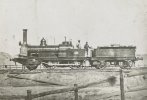
Keith Turton, of PO wagon fame, undertook extensive research during the 1970s into the contractor's locomotives used in Victoria, and published four or five articles in the ARHS Bulletin. There are no known photographs of 'Cornish' but several photos of a locomotive known to have been rebuilt from Cornish, and an 1860s sales notice listing the dimensions. More recently Daniel Gooch's specification for the Geelong locomotives have become available. The problem is the dimensions and descriptions do not match. There must have been two locomotives named 'Cornish'. It is recorded in official sources and contemporary newspapers that Cornish and Bruce purchased the ex Geelong and Melbourne Railway 0-6-0 goods locomotive 'Tubal Cain' and named it 'Cornish'. Tubal Cain was one of four 0-6-0 locomotives designed by Daniel Gooch at Swindon and built by R&W Hawthorns, builders numbers 927, 928, 929 and 930 of 1855. Tubal Cain is usually quoted as being builders number 928 but could have been 930. Tubal Cain was an 0-6-0 well tank with outside frames and 4'9" diameter wheels. A local newspaper recorded 'Cornish' arriving in Castlemaine during 1862 and states it had been purchased from the government. This Cornish was an 0-6-0 tender locomotive with 5' diameter wheels. It is reported to have been built by Hawthorns, probably correctly as the sales notice also states it is a Hawthorn locomotive. The builders number has been quoted since the 1970s as 928 but this cannot be correct so the builders number is unknown.
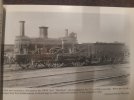
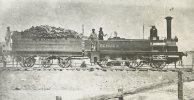
This photograph is the closest I have found to an image which might show some of the Geelong and Melbourne Railway goods locomotives. The locomotive on the passenger train is one of two ex G&MR 2-2-2WT passenger locos built by Stephensons which remained in service with Victorian Railways for many years, the larger passenger locos and the goods locos inherited from the G&MR saw little use.

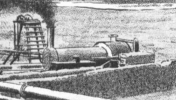
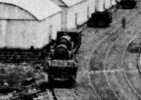
This is an enlargement of part of the image above which could show two of the goods locos, in partially stripped form between two wagons.
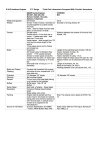
I put together a comparison of the Gooch Specification for the G&MR goods locos and the dimensions provided in the 1863 and 1868 newspaper sales notices, which also states that a full set of spares was also for sale, and gave the original purchase price - both strongly suggesting that the Cornish being sold was not the ex G&MR loco purchased from the Victorian Railways.
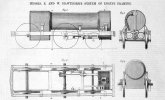
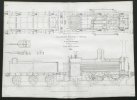
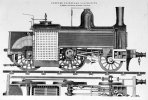
A Gooch drawing for two of the passenger locomotives built by Stothert and Slaughter survives. It is not completely clear. I could build a model of the boiler and frames but not sure how the rear bunker/tank, cab area and wing tanks would have looked. This is the drawing with some tracing over it to try and work out how it looked. A 2-2-2 tank with 6'6" flangeless driving wheels.

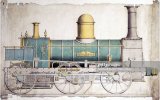
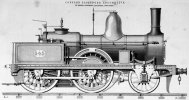
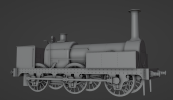
The four passenger locomotives built by Hawthorns alongside the goods locos shared the same dimensions and specification so probably looked similar but could have had detail differences. Using the Gooch drawing as a basis I have come up with this as a possible interpretation of how the goods locos looked, still a work in progress.

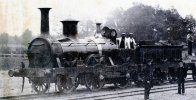
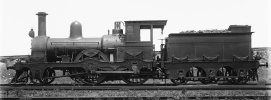
Part of the inspiration for the drawing is this photograph of Mars on the Whitehaven & Furness Junction Railway, built by R&W Hawthorns b/n 997 of 1857. It is a similar sized 0-4-2 locomotive built by Hawthorns and the HMRS have a copy of a drawing for it in their collection. Just a coincidence that William Meikle (my avatar portrait) was locomotive superintendent of the Whitehaven & Furness Junction Railway for many years before moving on to the Dublin, Wickford and Wexford Railway before moving to Melbourne and becoming Locomotive Overseer of the Victorian Railways, so was responsible for the W&FJR Hawthorn locos.

If anyone has knowledge of 1850s Hawthorns locomotive or ideas of how Tubal Cain should look I would like to hear before the model progresses too far. Also if anyone has any idea what the building number of the second 'Cornish' was I would be grateful, the agents were probably de Pass Brothers.
A start has been made, just. A set of Slaters broad gauge S7 carrying wheels work out close enough for 4'9" in 1:48 scale. The broad gauge axles have been turned down to move the wheels in to 5'3" gauge and shortened a little.

And just incase anyone needs more to read, this is the text of the 1862 newspaper article which has caused some of the confusion regarding Cornish -
Herald, Saturday 30 August 1862, page 5
Keith Turton, of PO wagon fame, undertook extensive research during the 1970s into the contractor's locomotives used in Victoria, and published four or five articles in the ARHS Bulletin. There are no known photographs of 'Cornish' but several photos of a locomotive known to have been rebuilt from Cornish, and an 1860s sales notice listing the dimensions. More recently Daniel Gooch's specification for the Geelong locomotives have become available. The problem is the dimensions and descriptions do not match. There must have been two locomotives named 'Cornish'. It is recorded in official sources and contemporary newspapers that Cornish and Bruce purchased the ex Geelong and Melbourne Railway 0-6-0 goods locomotive 'Tubal Cain' and named it 'Cornish'. Tubal Cain was one of four 0-6-0 locomotives designed by Daniel Gooch at Swindon and built by R&W Hawthorns, builders numbers 927, 928, 929 and 930 of 1855. Tubal Cain is usually quoted as being builders number 928 but could have been 930. Tubal Cain was an 0-6-0 well tank with outside frames and 4'9" diameter wheels. A local newspaper recorded 'Cornish' arriving in Castlemaine during 1862 and states it had been purchased from the government. This Cornish was an 0-6-0 tender locomotive with 5' diameter wheels. It is reported to have been built by Hawthorns, probably correctly as the sales notice also states it is a Hawthorn locomotive. The builders number has been quoted since the 1970s as 928 but this cannot be correct so the builders number is unknown.
This photograph is the closest I have found to an image which might show some of the Geelong and Melbourne Railway goods locomotives. The locomotive on the passenger train is one of two ex G&MR 2-2-2WT passenger locos built by Stephensons which remained in service with Victorian Railways for many years, the larger passenger locos and the goods locos inherited from the G&MR saw little use.
This is an enlargement of part of the image above which could show two of the goods locos, in partially stripped form between two wagons.
I put together a comparison of the Gooch Specification for the G&MR goods locos and the dimensions provided in the 1863 and 1868 newspaper sales notices, which also states that a full set of spares was also for sale, and gave the original purchase price - both strongly suggesting that the Cornish being sold was not the ex G&MR loco purchased from the Victorian Railways.
A Gooch drawing for two of the passenger locomotives built by Stothert and Slaughter survives. It is not completely clear. I could build a model of the boiler and frames but not sure how the rear bunker/tank, cab area and wing tanks would have looked. This is the drawing with some tracing over it to try and work out how it looked. A 2-2-2 tank with 6'6" flangeless driving wheels.
The four passenger locomotives built by Hawthorns alongside the goods locos shared the same dimensions and specification so probably looked similar but could have had detail differences. Using the Gooch drawing as a basis I have come up with this as a possible interpretation of how the goods locos looked, still a work in progress.
Part of the inspiration for the drawing is this photograph of Mars on the Whitehaven & Furness Junction Railway, built by R&W Hawthorns b/n 997 of 1857. It is a similar sized 0-4-2 locomotive built by Hawthorns and the HMRS have a copy of a drawing for it in their collection. Just a coincidence that William Meikle (my avatar portrait) was locomotive superintendent of the Whitehaven & Furness Junction Railway for many years before moving on to the Dublin, Wickford and Wexford Railway before moving to Melbourne and becoming Locomotive Overseer of the Victorian Railways, so was responsible for the W&FJR Hawthorn locos.
If anyone has knowledge of 1850s Hawthorns locomotive or ideas of how Tubal Cain should look I would like to hear before the model progresses too far. Also if anyone has any idea what the building number of the second 'Cornish' was I would be grateful, the agents were probably de Pass Brothers.
A start has been made, just. A set of Slaters broad gauge S7 carrying wheels work out close enough for 4'9" in 1:48 scale. The broad gauge axles have been turned down to move the wheels in to 5'3" gauge and shortened a little.
And just incase anyone needs more to read, this is the text of the 1862 newspaper article which has caused some of the confusion regarding Cornish -
Herald, Saturday 30 August 1862, page 5
FIRST LOCOMOTIVE ON THE LINE AT CASTLEMAINE.
The M. A. Mail says : — Yesterday, the first locomotive placed on the line in this district reached its destination, in safety after undergoing many troubles and trials. The tender was successfully launched on Wednesday, but the engine was the occasion of far greater anxiety. It was originally one of the Geelong Railway Company's engines, and came into the possession of the Government on the purchase of the Geelong line. Since then it has been thoroughly repaired and overhauled at the Railway Foundry here, and has been re-christened the "Cornish." At about one o'clock yesterday it made its exit from Cornish and Bruce's foundry, mounted on a truck constructed expressly for the transport of such ponderous bodies, and drawn by seventeen horses, the property of Latham and Co., as fine a set of animals as ever were harnessed. The engine was covered with flags, and as it passed up Barker street was the occasion of considerable curiosity, a large number of persons following to see its transhipment. All went well till reaching Parker street. As our readers are probably aware, the lower part of that street, though it has not been the subject of municipal improvements or experiments, as the case may be, is still in a very bad condition, and, when within about two hundred yards of the railway line, snap went the fore axle, and the huge load careened, as though about to capsize. This latter calamity, however, did not occur, and screwjacks having been promptly set to work, the broken axle was released and sent off for repair, whilst one end of the engine, sustained by the screwjacks, was hoisted in the air. The weight of the whole is about 17 tons, exclusive of the wheels. After a delay of nearly three hours, the broken axle, which had been welded in the meantime, was again attached, the truck lowered on to it, and another start made. Scarcely, however, had more than a few yards been accomplished, when another wrench took place, a linch pin was pushed out, and the faulty axle was bent till the wheels grated against the engine. Another halt was made, the screwjack put again into requisition, and the linch-pin, with some trouble, replaced. When this was effected, the load again set in motion, and to the great relief of all engaged was safely placed on the line ready for raising on to its wheels. During the last part of the work the axle gave way slightly, and had there been another hundred yards to traverse, would have in all probability again broken in half. Three cheers were given heartily on the arrival of the engine at its destination. In the course of to-day steam will, we believe, be got up in the Cornish, if placed on the rails without accident and in sufficient time. It is intended to use the engine to draw ballast trucks, and we understand its use will greatly facilitate the operations of the contractors. The line, we may observe, has been excellently constructed, though delay has been occasioned through the late wet weather. The contractors for the works in the neighbourhood have faithfully done their part, and not a slip or fault of any kind has been manifested. The engine can now travel from here to the Porcupine, and very shortly will be able to extend its journey to Bendigo. Apropos of the railway and railway matters, we are glad to state that the inactivity complained of by our Sandhurst contemporary in the erection of the station has not been shown in Castlemaine, and the contract is being pushed rapidly forward. Owing to the soft nature of the ground, and also to the fact that the site has been honeycombed by the diggers, considerable and unexpected difficulties have arisen in laying the foundations, as much as from 16 to 20 feet having to be gone through before reaching the bed-rock. Altogether, we have great reason for congratulation at the energetic manner in which the whole works in connection with the railway are being carried out, and in a very few weeks, if the weather holds up, we shall realise that long, desired boon - railway communication between Sandhurst, Castlemaine, and Melbourne.
The M. A. Mail says : — Yesterday, the first locomotive placed on the line in this district reached its destination, in safety after undergoing many troubles and trials. The tender was successfully launched on Wednesday, but the engine was the occasion of far greater anxiety. It was originally one of the Geelong Railway Company's engines, and came into the possession of the Government on the purchase of the Geelong line. Since then it has been thoroughly repaired and overhauled at the Railway Foundry here, and has been re-christened the "Cornish." At about one o'clock yesterday it made its exit from Cornish and Bruce's foundry, mounted on a truck constructed expressly for the transport of such ponderous bodies, and drawn by seventeen horses, the property of Latham and Co., as fine a set of animals as ever were harnessed. The engine was covered with flags, and as it passed up Barker street was the occasion of considerable curiosity, a large number of persons following to see its transhipment. All went well till reaching Parker street. As our readers are probably aware, the lower part of that street, though it has not been the subject of municipal improvements or experiments, as the case may be, is still in a very bad condition, and, when within about two hundred yards of the railway line, snap went the fore axle, and the huge load careened, as though about to capsize. This latter calamity, however, did not occur, and screwjacks having been promptly set to work, the broken axle was released and sent off for repair, whilst one end of the engine, sustained by the screwjacks, was hoisted in the air. The weight of the whole is about 17 tons, exclusive of the wheels. After a delay of nearly three hours, the broken axle, which had been welded in the meantime, was again attached, the truck lowered on to it, and another start made. Scarcely, however, had more than a few yards been accomplished, when another wrench took place, a linch pin was pushed out, and the faulty axle was bent till the wheels grated against the engine. Another halt was made, the screwjack put again into requisition, and the linch-pin, with some trouble, replaced. When this was effected, the load again set in motion, and to the great relief of all engaged was safely placed on the line ready for raising on to its wheels. During the last part of the work the axle gave way slightly, and had there been another hundred yards to traverse, would have in all probability again broken in half. Three cheers were given heartily on the arrival of the engine at its destination. In the course of to-day steam will, we believe, be got up in the Cornish, if placed on the rails without accident and in sufficient time. It is intended to use the engine to draw ballast trucks, and we understand its use will greatly facilitate the operations of the contractors. The line, we may observe, has been excellently constructed, though delay has been occasioned through the late wet weather. The contractors for the works in the neighbourhood have faithfully done their part, and not a slip or fault of any kind has been manifested. The engine can now travel from here to the Porcupine, and very shortly will be able to extend its journey to Bendigo. Apropos of the railway and railway matters, we are glad to state that the inactivity complained of by our Sandhurst contemporary in the erection of the station has not been shown in Castlemaine, and the contract is being pushed rapidly forward. Owing to the soft nature of the ground, and also to the fact that the site has been honeycombed by the diggers, considerable and unexpected difficulties have arisen in laying the foundations, as much as from 16 to 20 feet having to be gone through before reaching the bed-rock. Altogether, we have great reason for congratulation at the energetic manner in which the whole works in connection with the railway are being carried out, and in a very few weeks, if the weather holds up, we shall realise that long, desired boon - railway communication between Sandhurst, Castlemaine, and Melbourne.