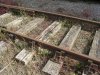
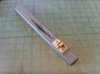
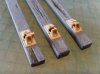
28ten said:
Overall I prefer ply and rivet in terms of adjustment so its probably best to do a small test piece, I have a feeling Dan was looking at sleepers as well.
I pretty much decided on C & L plastic sleepers with Exactoscale chairs some time ago. I used ply sleepers in my P4 days, but was never happy seeing the exposed sides or ends of the sleepers (as sometimes happens in lightly ballasted areas, such as sidings), due to the alternating layers being visible. I also found them difficult to distress convincingly, but have had far better results with ABS sleepers. Here's a picture of some plastic C & L sleepers and Exactoscale chairs (7mm scale), I put together and distressed some time ago (I even removed some of the keys from the chairs!) ....
[attachment=0:flscu5vo]
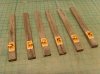
The sleepers were distressed with the aid of a sharp scalpel blade, by scoring (quite deeply), in the same spot several times and gouging bits out as required. The action of scoring in the direction of the grain means there is always the impression that you're looking at a solid piece of wood, but if any areas you gouge out appear too smooth, just dig the blade in a few more times!

There were shiny areas around the chairs where the solvent had been sloshed around, but this soon disappears after a visit from the glass fibre stick. I keep meaning to make a diorama similar to the one Martyn Welch uses to photograph his models and a few more of these distressed sleepers, a lick of paint, some ballast and a few weeds ought to look reasonably good.
Getting back to the timber tracks though, I was thinking they might look a bit odd for points, as the grain on
some of the diverging route sleepers (in the area beyond the crossing vee), might be running kind of diagonally, as opposed to parallel to the sleeper edges, if you see what I mean?
Regards
Dan



 I'll pop back in and edit it.