Birmingham & Gloster Rly, Slatted Wagon (my title)

Mike W

Western Thunderer
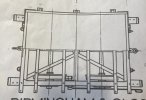
I don't like the tapered posts idea because it wiggle its way down in transit, jam up solid and soon need a hammer to get them out. Those posts along the sides and ends could have small wider sections to locate onto the tops of the straps (a blacksmith's job), but the drawing is simplified so as not to show them? Or could the straps and the sections of posts below them actually be a housing and the bottom part of the posts are reduced in size to locate in them - i.e. the bottom is part of the housing not part of the post as it appears?
The whole upper structure, including that wide plank, could lift off as one, but why would it?
How high are the sides? I'm thinking whether the loads (not livestock!) could be lifted over?
I truth, I have no idea! But it will be an interesting model.
Mike
 

Jon Nazareth

Western Thunderer
Mike
I should have gone over the drawing more thoroughly before I even started the build. That way, I would have noticed all of the ‘unknowns’ and most probably not even have started the build! Too far down the road to scrap it now.

Jon
 

cctransuk

Western Thunderer
I don't like the tapered posts idea because it wiggle its way down in transit, jam up solid and soon need a hammer to get them out.
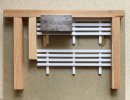
Correct me if I misunderstand but - are we not talking about ballast wagons converted for general traffic. Moreover, this is very early railwaying - better ways of doing things came later with experience.

There is no evidence - is there? - that the conversion was intended to be reversible. Ease of loading was a consideration that came with development.

..... and big hammers were an essential implement in the days of blacksmith engineering!

John Isherwood.
 

Jon Nazareth

Western Thunderer
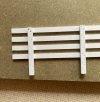
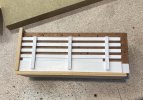
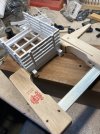
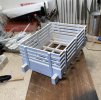
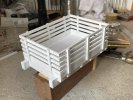
Would you Adam and Eve it, one step forward and two steps back. I fixed the outside uprights in the wrong place and had to remove them then, refix in the right position. If you look at the previous photo, you will see them fixed at the end of the slats, wrong! This photo shows them corrected.

Jon

IMG_5678.jpeg
 

Ian@StEnochs

Western Thunderer
Mike
I should have gone over the drawing more thoroughly before I even started the build. That way, I would have noticed all of the ‘unknowns’ and most probably not even have started the build! Too far down the road to scrap it now.

Jon


Jon.

If you wait until you have all of the information and details before you start to build a model then you are most unlikely to build anything! This is especially true of less common prototypes where there are few drawings and often fewer or no photographs.

One thing in your favour thought is that what you build may not be 100% correct but will most probably look very like the original AND it is highly questionable that anyone will be able to prove your model wrong.

More power to your elbow,

Ian.
 

Jon Nazareth

Western Thunderer
IMG_5682.jpeg
I made up an extra piece to go on top of the dumb buffer. I didn’t have the correct size of styrene section and so, I made one up. In the past, I’ve been unsuccessful in joining two pieces of styrene flat to flat as the mek-pak doesn’t penetrate the join. This time, I thought that I’d glue the pieces with some 60 second loctite. On the face of it, it worked that is, until I came to machine off square the ends of the dumb buffers. The glued on pieces simply popped off! I was more than a little annoyed, to say the least. It was impossible for me to realign properly and apply some solvent in the hope that they would stay in place so, I’ve left them off. A bit of a shame as I liked the look of those over sized buffers. Luckily for me, I placed the four extra components with the thin piece uppermost. Gawd knows what I’d have done with regards to a repair if it had been the other way around.

IMG_5683.jpeg
Here I’ve attached two pieces of styrene as a 45° set square in order to mark off for the dummy fixings of upright to slat.

IMG_5684.jpeg
Here one side has been marked up, drilled .5mm and cleaned up. I’m going to use some .5mm diameter rivets to simulate a fixing. This is the outer face. On the inner face, I’m going to leave them very slightly raised to show that the fixing does go right through. Yes, as can be seen, I’ve changed the way that this section fixes to the side.

Jon

Looking at those rivet heads again, I may just flatten them off a tad.
 
Last edited:
Top