
You are using an out of date browser. It may not display this or other websites correctly.
You should upgrade or use an alternative browser.
You should upgrade or use an alternative browser.
B1 - 61161
- Thread starter Dave Holt
- Start date

Dave Holt
Western Thunderer
Of course, you're perfectly correct, Peter. However, I've chickened out and designed an etched version which is now in hand.
I am currently doing battle with the sand pipes - a job I hate and try to put off as long as possible. All that trying to get multiple bends in different planes to get the final shape. Bending 0.45 mm brass wire shouldn't be hard, but I find this job very trying.
That said, the front and front middle pipes are made and fitted. They will probably require some adjustments with the wheels back in and the chassis standing on the track.

Rear ones still to do. The mounting brackets and top steadying tubes are already in place.
All the sanding bits are part of the keeper plate as they have to be removable to fit/remove the wheel sets. The top ends slide into lengths of tube soldered inside the frames to steady them as the support brackets are a bit flimsy.
Dave.
I am currently doing battle with the sand pipes - a job I hate and try to put off as long as possible. All that trying to get multiple bends in different planes to get the final shape. Bending 0.45 mm brass wire shouldn't be hard, but I find this job very trying.
That said, the front and front middle pipes are made and fitted. They will probably require some adjustments with the wheels back in and the chassis standing on the track.
Rear ones still to do. The mounting brackets and top steadying tubes are already in place.
All the sanding bits are part of the keeper plate as they have to be removable to fit/remove the wheel sets. The top ends slide into lengths of tube soldered inside the frames to steady them as the support brackets are a bit flimsy.
Dave.

P A D
Western Thunderer
Of course, you're perfectly correct, Peter. However, I've chickened out and designed an etched version which is now in hand.
No chickening out involved Dave. Just another way to skin the cat.
I feel the same about sandpipes. Once I get back on the chassis of the Fowler 4P, I'll have to steel myself to do the sanding gear.
Your chassis is progressing nicely.
Cheers,
Peter


Dave Holt
Western Thunderer
Thanks Tony. I have a pair of round nosed pliers, tapering from about 1 mm diameter at the tips to 4.5 mm at the base. Otherwise I use drill shanks for larger radii. With sand pipes, it's figuring out the orientation of the various bends in three dimensions that I find the worst.
Anyway, I've completed the pipes. including some tweaking after fitment and, as far as I can see, that's the loco chassis complete (except for the tender draw bar). It's been re-assembled - quite tricky to get the keeper plate into position whilst engaging the tails of the sand pipes into their guide tubes.
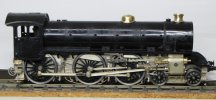
Here's the loco in it's most complete state yet and it does look a bit like a B1. The chimney and dome are just loosely placed.

On with the body next. I can't decide whether ot not it was painted by Bachmann. It's obviously moulded in black plastic and a brief trial with Phoenix Precision stripper had no apparent effect. However, the Bachmann Ivatt tanks body, also in black plastic, had most definitely been painted, as I discovered when I used cellulose thinners for degreasing, fortunately with no irretrievable results. On another thread, someone suggested immersion in a caustic soda solution, so I might try that before starting on the detailing.
Dave.
Anyway, I've completed the pipes. including some tweaking after fitment and, as far as I can see, that's the loco chassis complete (except for the tender draw bar). It's been re-assembled - quite tricky to get the keeper plate into position whilst engaging the tails of the sand pipes into their guide tubes.
Here's the loco in it's most complete state yet and it does look a bit like a B1. The chimney and dome are just loosely placed.
On with the body next. I can't decide whether ot not it was painted by Bachmann. It's obviously moulded in black plastic and a brief trial with Phoenix Precision stripper had no apparent effect. However, the Bachmann Ivatt tanks body, also in black plastic, had most definitely been painted, as I discovered when I used cellulose thinners for degreasing, fortunately with no irretrievable results. On another thread, someone suggested immersion in a caustic soda solution, so I might try that before starting on the detailing.
Dave.
P A D
Western Thunderer
Looks like we agree then. Sandpipes suck!
I've also got a pair of tapered round pliers which I use when making the bends in sand pipes.
I have to say again Dave, I don't know how you do such great work in 4mm scale! It looks very impressive with the body on. Can't wait to see it finished.
Cheers,
Peter
I've also got a pair of tapered round pliers which I use when making the bends in sand pipes.
I have to say again Dave, I don't know how you do such great work in 4mm scale! It looks very impressive with the body on. Can't wait to see it finished.
Cheers,
Peter
Dave Holt
Western Thunderer
Work has switched to the tender, with further progress on the chassis - I found forming and getting a good fit for the well tank quite difficult - and a start on the basic body shell, as suggested in the instructions. Here are the two parts fixed together. I opted to make provision for alternative front fixings so that the brake cylinder can be fitted.


Sadly, I couldn't find a supply of invisible solder used by various people who post on here.
Not sure whether to go back to the chassis or carry on with the body, or a bit of both.
Dave.
Sadly, I couldn't find a supply of invisible solder used by various people who post on here.
Not sure whether to go back to the chassis or carry on with the body, or a bit of both.
Dave.
Dave Holt
Western Thunderer
Yes, Peter. There's isn't a prototypical coal space as the kit leaves the option of a tender mounted motor (with shaft drive) and Dave B considered that as most models are fully coaled, the lack of coal space doesn't matter. I suppose the kit could be altered, but mine will be well coaled so it's not an issue. The sub structure forms the basis for half etched overlays but also provides for the internal gussets in the coal space.
Still lots to do.
Dave.
Still lots to do.
Dave.
Last edited:
Dave Holt
Western Thunderer
Made some further progress with the tender body. I've progressed this in preference to the chassis because the fold-up gussets along the top kept getting caught during handling and I feared one or more fatiguing off with repeated bending and straightening. They're all now folded up and the bends reinforced with solder.
The kit provides for several options for the coal space bulkheads - low or high for both front and rear. It seems that the precise combination for any given loco at a specific time is an absolute minefield and my lack of knowledge of things ex-LNER is a major disadvantage.
I had settled on a high front and low back plate, the latter in its original rearward position, straddling the scoop dome. I then started to worry about my chosen loco (61159) and its allocation during the mid to late 1950s. After some deliberations, I have decided to change to 61161 because that loco remained at Gorton shed till 1959. I then found a photo on the web that shows that 61161 had a modified tender with the high back moved forward clear of the dome.
Unfortunately, by this stage I had already removed the representation of the remains of the old. low coal plate from the dome casting, so have had to reinstate it using 5 amp fuse wire soldered into a saw cut. It's not quite in the centre but is better than nothing.
Here's the inner body with the front and rear tank top details added.


Rear and side body overlays next.
Dave.
The kit provides for several options for the coal space bulkheads - low or high for both front and rear. It seems that the precise combination for any given loco at a specific time is an absolute minefield and my lack of knowledge of things ex-LNER is a major disadvantage.
I had settled on a high front and low back plate, the latter in its original rearward position, straddling the scoop dome. I then started to worry about my chosen loco (61159) and its allocation during the mid to late 1950s. After some deliberations, I have decided to change to 61161 because that loco remained at Gorton shed till 1959. I then found a photo on the web that shows that 61161 had a modified tender with the high back moved forward clear of the dome.
Unfortunately, by this stage I had already removed the representation of the remains of the old. low coal plate from the dome casting, so have had to reinstate it using 5 amp fuse wire soldered into a saw cut. It's not quite in the centre but is better than nothing.
Here's the inner body with the front and rear tank top details added.
Rear and side body overlays next.
Dave.
Dave Holt
Western Thunderer
Short answer is "yes".
I had a fairly disasterous experience with a Stanier 4000 gallon tender that had half etched overlays (Comet, I think) but managed to recover it following tips from a friend - lower melt solder (145, I normally use flux cored electrical solder - 188? for general fabrication), small tacks at intervals and allowing everthing to cool down between, then fill in more tacks in between and finally join up the tacks, again letting it cool down to avoid excessive expansion of the overlay.
It worked well, so that's how I intend to approach this one; holding my breath.
Dave.
I had a fairly disasterous experience with a Stanier 4000 gallon tender that had half etched overlays (Comet, I think) but managed to recover it following tips from a friend - lower melt solder (145, I normally use flux cored electrical solder - 188? for general fabrication), small tacks at intervals and allowing everthing to cool down between, then fill in more tacks in between and finally join up the tacks, again letting it cool down to avoid excessive expansion of the overlay.
It worked well, so that's how I intend to approach this one; holding my breath.
Dave.
Dave Holt
Western Thunderer
I've changed the thread title to reflect the new number I've sellected.
Yes, Ihave contemplated gluing half etched overlays but haven't summoned the courage to actually try it.
The rear end and first side overlays are now on, fitted by firstly tacking at various points, mainly round the edges, but also a couple at the large holes seen in the inner bady shell. Managed to keep it all quite flat. I used pairs of magnets, inside and out, to clamp the overlay whilst I pressed it down, local to the tacks, with my ceramic tipped tweezers.

Looks like there needs to be a little more cleaning up along the bottom edge.
I won't show the inside as the so;dering is a bit rough and ready - definately not in the Mickoo or PAD tradition.
Dave.
Yes, Ihave contemplated gluing half etched overlays but haven't summoned the courage to actually try it.
The rear end and first side overlays are now on, fitted by firstly tacking at various points, mainly round the edges, but also a couple at the large holes seen in the inner bady shell. Managed to keep it all quite flat. I used pairs of magnets, inside and out, to clamp the overlay whilst I pressed it down, local to the tacks, with my ceramic tipped tweezers.
Looks like there needs to be a little more cleaning up along the bottom edge.
I won't show the inside as the so;dering is a bit rough and ready - definately not in the Mickoo or PAD tradition.
Dave.
Last edited:

45609
Western Thunderer
Looks good Dave. If I’d have seen your previous post earlier I would have said don’t worry about the overlays. I had no problems on the 3500 gallon tender shown earlier in this thread. Random tacking with 145 solder is just the right approach. I support the outside by pressing it against the underframe with a variety of wooden blocks while dropping in a tack. The tacks eventually are all joined up.
Funny you should mention a previous problem with a Comet tender. I had that too on one of their 4000g welded Stanier tenders. It was a long time ago and I perhaps wasn’t as experienced at building but it makes me wonder if the brass might have been a bit too thin.
Finally don’t apologise for your soldering. I always say to people that mine is functional not neat. I’ve had a few locos across my workbench over the last 10 to 15 years, built by “pros”, for repairs usually due to, in my humble opinion, an insufficient amount of solder being used. I personally don’t ration it. There is no need and very little of what I’ve built has come apart.
Keep up the good work…Morgan
Funny you should mention a previous problem with a Comet tender. I had that too on one of their 4000g welded Stanier tenders. It was a long time ago and I perhaps wasn’t as experienced at building but it makes me wonder if the brass might have been a bit too thin.
Finally don’t apologise for your soldering. I always say to people that mine is functional not neat. I’ve had a few locos across my workbench over the last 10 to 15 years, built by “pros”, for repairs usually due to, in my humble opinion, an insufficient amount of solder being used. I personally don’t ration it. There is no need and very little of what I’ve built has come apart.
Keep up the good work…Morgan
Dave Holt
Western Thunderer
Thanks for your thoughts, Morgan.
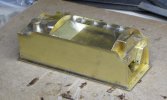
Second side fitted without any angst and sloping coal plate and fire iron tunnel also fitted. I haven't soldered every joint continuously, enough to hold everything in place and fill any visible gaps. I hope this approach doesn't get me bannished from WT.

On with the detailing next.
Dave.
Second side fitted without any angst and sloping coal plate and fire iron tunnel also fitted. I haven't soldered every joint continuously, enough to hold everything in place and fill any visible gaps. I hope this approach doesn't get me bannished from WT.
On with the detailing next.
Dave.