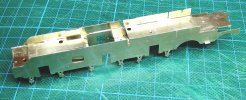
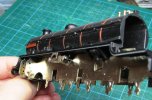
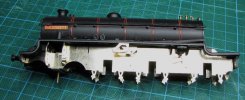
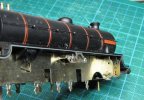
B1 - 61161

Dave Holt

Western Thunderer
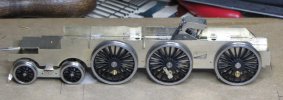
Whilst waiting for some custom detailing parts for the Ivatt tank, I've made a start on a Dave Bradwell chassis for a B1 loco.
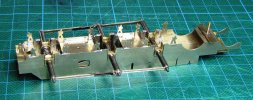
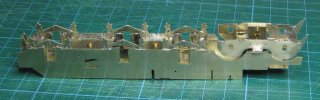
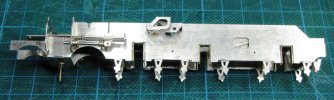
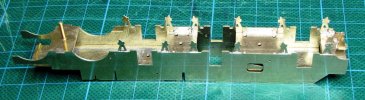
So far, I've prepared some etched parts and folded up the inner chassis and positioned the outer frames, as shown below.
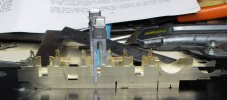
B1_001.JPG
Construction will basically follow Dave's instructions but one deviation so far has been to double up the material thickness where holes have to be tapped 10BA. Not sure why such massive screws are used, 14BA would be more than adequate and less intrusive.
Dave.
 

Dave Holt

Western Thunderer
The front bogie has been assembled to near completion and trial fitted under (or above, when upside down!) the frames.
B1_008.JPG
The bogie work has allowed me to put off a couple of tricky aspects of the frames - the axlebox spring locators (fiddly) and slotting the horns to take the driving wheel spring wires (terrifying with the risk of wrecking the whole chassis). Won't be able to avoid these indefinitely if the loco is ever to run.
Dave.
 

Dave Holt

Western Thunderer
Well. After nearly a two year gap, work has restarted on the B1. I finally bit the bullet and cut the slots for the coupled axle sprigs using a cutting disc in a small drill. My fears proved unfounded and all is well. Still haven't decided the best way to drill out the 10 BA grub screw adjusters to take the spring tails.
Instead, I've started work on the slide bar/crosshead assemblies. The left hand has been prepared and trial fitted, loose, in the cylinder unit. Lots and lots of filing was required on the cast brass crossheads to get a good sliding fit in the bars. This one seems all right now.
B1_009.JPG
Dave.
 

Dave Holt

Western Thunderer
LH slide bars and crosshead assembly now soldered up but only loose in the cylinder. An awful lot of filing of the cast brass crosshead was required to get a good sliding action in the bars. Got there in the end.
B1_011.JPG
I've commissioned some very small etches to build up the oil pots that are mounted just above the gudgeon pin.
Dave.
 

Dave Holt

Western Thunderer
A bit more progress with the B1, but it's slow going. The chassis is now partially wheeled, currently as a 4-2-0-2. Despite seemingly careful measurements for spacing washers, the front coupled axle was a tad too tight on first fitting, so I was forced to take the wheels off the axle to fit slightly thinner washers. I really don't like to do this with press fit plastic wheels but the re-fitted wheels seem quite tight on the axle so, hopefully, all will be well.
The centre wheels have not been fitted as a few issues need to be sorted. The Ultrascale long bushes require shortening and even so the crankpin screws will be too long to seat in my GW wheel quartering/press tool, so some method of packing out will be needed. There is something odd about these long bushes. All other Ultrascale bushes I've used have been 1.5 mm diameter and bright machined finish. However, these long bushes are a dull surface and measure 1.55 mm diameter, as if they have not been machined on the outside. Not a huge problem, but it has taken quite an effort with a small broach to open the coupling and connecting rod holes to give a good fit.
B1_012.JPG
Actually, I'm being a bit naughty doing this work on the B1 as I'm supposed to be building the L&Y Class 27 chassis seen in the foreground for friend Davis Clarke in exchange for his work on my Ivatt Class 2 tank. Sorry, David! Will get back to it soon. Promise.
Interestingly, whilst both chassis are fully sprung, the Cl 27 uses CSBs, clearly visible on the RHS, the Bradwell B1 uses individual, adjustable springs for each axlebox.
Dave.
 

Dave Holt

Western Thunderer
Due to the width of the coupling rod and connecting rod bosses, my usual method of attaching the return crank wont work on this loco. Instead, I'm using a modified Ultrascale long bush (suitably shortened a bit) with the return crank hole tapper 14 BA. This change also denies my usual method of getting the crank tightened at the correct angle. To achieve the correct setting of the crank, I drilled out the Gibson crankpin hole to 1 mm so the screw can be tightened with the crank correctly set, which has to be done before pressing the wheels onto the axle. A jig was made from brass tube and wire to set the desired offset from the axle centre and the screws tightened into the crank with Araldite applied to the part inside the wheel boss and small staples set into the screw head slot to prevent any rotation of the screw.
Hope it works!
B1_013.JPG

B1_014.JPG
Wheels with the return cranks set, one with the locating jig in place. Crank pins to be cut off flush once the epoxy has cured.
Dave.
 

Dave Holt

Western Thunderer
Hmmm. That's been a bit of a struggle. The coupling rods are now fitted and a not quite perfect rolling chassis achieved. A little more tweaking of crank pin holes might be required. The main problem is a tendency to unscrew the recessed front retainers when pushed back and forth. This is not helped by a noticeable wobble on the LH centre driving wheel resulting from a problem pressing the wheels on using my GW quartering press tool. Not sure if it's possible to tease it back to square to the axle.
Also added is the gearbox torque strut. With this, I've deviated from my usual practice and am trying a single sided arrangement suggested by Simond on a previous model post. Time will tell.
B1_016.JPG
Dave.
 

Dave Holt

Western Thunderer
A bit more progress, with the slide bar/crosshead/connecting rod assemblies fitted. The body is just plonked on for effect (and to check where lead ballast can be fitted without conflicting with parts of the chassis).
B1_018.JPG
The rather over-scale hand rail knobs and some other parts have been removed from the body, partly to allow access for filing/scraping the moulded boiler bands off and to be replaced with better scale items.
Dave.
 

Dave Holt

Western Thunderer
A bit more progress with the B1 whilst I gather myself to tackle the L&Y Class 27 (mentioned previously) tender.
The body has been weighted with lead sheet so that the springs can be adjusted to give the correct ride height. Pickups have been fitted and the chassis tried under power. Not too bad but will probably benefit from some running in.
The cylinders have been assembled and are complete except for the drain cock operating rods.
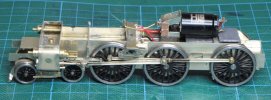
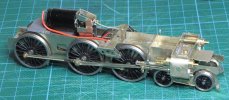
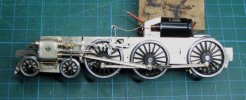
Here's the current state of play with the chassis.
B1_019.JPGB1_020.JPG

Dave.
 

Dave F.

Western Thunderer
Hi Dave, I'm at a similar chassis building stage to you though I'm using a Hornby body so it being an early Bradwell chassis it has had to be modified to suit, I believe Dave's later chassis have been redrawn to suit either bodies.
The B1 'GNU' trots round Wharfeside nicely with it's six Gresley and Thompson coaches on a Blackpool illuminations special from the North East.
Valvegear was to be next but I've had to replace a lead driving wheel due to a slight problem with concentricity I also took the opportunity to replace the crankpins with a 1.5mm o/d brass tube tapped to 14BA to take a countersunk bolt the head of which is just large enough to locate the rods this will help the tight clearances with the connecting rods even in EM.

Dave F.
 

45609

Western Thunderer
The B1 progress is good to see Dave.

Dave F, please could you briefly summarise what changes were needed to mod the Mk1 Bradwell B1 chassis kit to fit the Hornby body?

Thanks…Morgan
 

Dave Holt

Western Thunderer
I haven't found clearance between coupling and connecting rods to be a problem. I took Dave B's advice in the instructions to have the fronts of the driving wheels (Gibson) machined flat, flush with the outside of the rim. As per my usual method, I have use modified Ultrascale crank pin bushes (the rear washers are thin etched items I commissioned, and are soldered to the bushes and filed flush on the back rather than plugging into the face of the wheel as intended by Ultrascale). This has resulted in about 0.65 mm clearance between the con rod and coupling rods. In fact, I needn't have bothered with a recessed crank retainer on the front pins. The main problem is that the backs of the coupling rods are only 0.25 mm clear of the wheel rims, which doesn't leave much allowance for any wheel wobble and side play. It will be interesting to see if the loco has problems on curves.
I've attempted to show the clearances in this photo.
B1_021.JPG
Dave.
 

Dave Holt

Western Thunderer
A start has been made on the valve gear. The LHS is more advanced than the RH.
Here it is temporarily fitted.
B1_026.JPG
I can complete the eccentric rod/return crank but that's as far as I can go at present. Unfortunately, I wrecked on of the anchor links and now have to wait whilst some replacements are produced, possibly early next year.
Dave.
 

Dave Holt

Western Thunderer
T'other side - looking remarkably similar.
B1_027.JPG
Actually, it's a bit of a relief to reach this stage on this side because I inadvertently snapped off the inside portion of the radius rod forked front end whilst trying to form it from the flat etch. I had reattached the broken piece with solder, but was concerned it might come adrift again when soldering in the pivot wire. Use of lower melt (145) solder, use of pliers as a heat sink and being quick resulted in a very satisfactory outcome.
Trouble is, there are two more similar forked joints to form on the eccentric rods. Gulp!
Dave.
 

Dave F.

Western Thunderer
Looking good Dave. I've still got a torque reaction arm to fit but the loco seems to perform well hauling a train although when you reverse the train into it's alloted siding the motor clunks against the body so the arm needs to go in asap but I'm busy with other things at the moment...
I helped out on another Bradwell B1 chassis for someone years ago and did the same as you with the radius rod fork but solder sorted it and as far as I know the loco is still running. I found the expansion link very fiddly too.

Dave F.
 

Dave Holt

Western Thunderer
Thanks, Dave. As you say, the expansion links are very fiddly. The first eccentric rod is done and temporarily fitted to the chassis.
B1_028.JPG
To avoid repeating the previous problem forming the forked end, I cheated a bit and severed the back layer so i could deal with the fork and align the large end boss layers separately. Seem to have worked a treat. Cast bearing cover to do.
Dave.
 
Top