I have started to think about the wider plan for the north-west corner — beyond the short length of fence in my previous post.
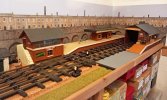
First, I have had to clear the base-boards. As with the rest of the layout, everywhere that I had not laid track, over c.20 years the finished base-boards gradually turned into storage space and/or work surfaces. Here is the area under consideration:
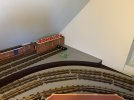

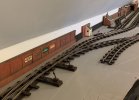
The seven tracks visible are, front to back: Track into Cairnie Junction platform 2 and centre road from Rivermead Central and main line; carriage siding accessed from centre road; track serving platform 1, on main line, 3’ 6” radius curve; sunken track — the Cavendish Goods branch; tracks 5 and 6, Cairnie Junction north yard, and; rearmost track, Benham’s private siding.
I had originally intended to have the platform 1 (main) station building on this curve and have platform 1 extending several feet around the curve. That is no longer my intention because of the clearance issues with long locomotives on a 3’ 6” radius curve requiring the platform to be absurdly far from the track. The platform will however have to extend a short way round the curve or the platform will not be long enough.
Another complication is the need to raise the ground level to clear the tops of trains using the Cavendish Goods branch. And to have at least one lift-out or hinged section to give access to a stalled or derailed train on the branch. In my original plan, the raised ground over the Cavendish Goods track was the curving section of platform 1, the access facility a lift-off station building.
Very provisionally, my thinking is roughly this for the area inside the red line, though I stress we are not yet even close to an outline planning application:

The hatched blue area is the northern end of platform 1. The yellow is the access road. The green, The Station Hotel. Between the Benham’s factory building and the road, not marked, a three-storey stone-built factory. In between, areas used for car-parking or landscaping around the hotel. But the arrangement must deliver the ground level and access required for the Cavendish Goods branch. And, at the moment, I am not sure quite how to do that.
Anyway, as can be seen, I brought in a Minic Aveling & Porter steam roller to do some site preparation after removing the accumulated ‘stuff’ from the back of the base-board. Another charming Minic model. Wind it up, it sets off in one direction for about 10”, stops, pauses, and reverses direction. It continues back and forth, rolling the ground, until the spring has run down when the motor disengages. I don’t know how this works. It’s a bit rapid at first, but soon settles down to a very realistic representation of a road roller at work. And the model really does appear to be working as the connecting rod moves prototypically, driven from the wheels via the flywheel and a crankshaft.
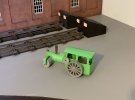
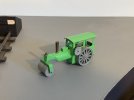
This is a post-WW2 model. The pre-WW2 version had painted wooden wheels. The usual colour was a much darker green. The rearing horse logo of Aveling & Porter is just visible embossed into the sheet metal above the pivot for the front roller.
What a clever and sophisticated toy/model costing only a few shillings when new! The Minic range was really very intelligently and thoughtfully designed. It’s a road roller, so it has to work like one. There’s humour too. The learner’s car, a standard model but with L-plates attached. Or so it appears. But actually, although the driven wheels look like they have the standard Minic metal hubs with rubber tyres, they are in fact all-metal with painted on ‘tyres’. So they don’t grip. The model proceeds erratically, wheels spinning furiously. It’s got a learner driver, so it must behave like it.
Martin