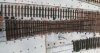
Hartley Hills, LNWR c1900 - buffer stops, how do you build yours?

Dog Star

Western Thunderer
I see the beans did get eaten then Graham?:)
No, did not.

Introducing, on my right, an aid for every track-builder who has to wait for the butanone to evaporate (and for the gloop to solidfy)... "waits" for applying pressure to the up-and-coming bond.

Apart from the fact that one of the tins is Chicken Soup, other brands of beans are available.
 

SimonT

Western Thunderer
I had similar problems building the crossing on Aber. Eventually I gave up building the Ks and other crossings in jigs and just built in situ. This requires creative use of the flange way slip gauge, among others, and the presence of a third hand that works from the top of the head and which has an eye on a convenient finger. The order of construction was dictated by the requirement to get lengths of track through which the test wagons could be pushed for testing. All seemed good and I wired it up. One of the 37s bangs through one particular crossing, where no other vehicle has a problem, yet the wheels sets of the 37 pass all tests. Ho hum.

Using lengths of rail that are long enough to set the alignment seemed to me to work best. They are cut to size when the crossing looks satis. When working out from a finished rail, use a cast brass fishplate to hold the end of the rail while the alignment is found. And I use my expensive V blocks as solvent setting fingers.

Anyone remember the colossal bang going into the down loop platform(8?) at Donny? Proves that the 125s were too light!

All the best

Simon
 

Dog Star

Western Thunderer
Who spotted the silly mistake in the assembly of the obtuse crossings? Here is a link to a LNWR drawing of the prototype:-

http://www.westernthunder.co.uk/ind...e-diamond-takes-shape.1170/page-15#post-79412

and here is a link to a photo of the model equivalent:-

http://www.westernthunder.co.uk/ind...e-diamond-takes-shape.1170/page-15#post-80177

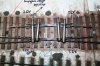
I solder brass straps across the underside of the rails wherever there is a block chair or a knuckle piece - the photo of the model crossing shows seven straps. I had overlooked the fact that the outer chairs at each end are a check chair (CCL or CCR in general parlance) and a bridge chair (aka L1) so the outer straps should have been soldered across just the check rail and the tongue rail. Whilst not a problem for the check chair, which is formed by cutting / pasting two standard chairs, the strap got in the way of the bridge chair. A short exercise with piercing saw, smooth barrette and 400 grit emery sorted the matter and a bridge chair now fits correctly.

Today saw the fitting of one obtuse crossing and the adjacent stock rail - almost halfway there now. The effort in creating a reference rail and cutting a pre-curved rail for other short sections has paid off in that the "Down Main" flows through the crossing in a smooth path.

hh-diamond-8.jpg

My apologies for the poor photo, I need some advice on how to defeat the automatic focus / aperture mechanism... Heather, are you listening?

regards, Graham
 

Dog Star

Western Thunderer
Heather, in case you want to read round the subject, the answer is 350D because the Good Lady does not trust me with the 5D.
 

Dog Star

Western Thunderer
The diamond continues to take shape... with the first rail of the Down Main through the diamond the time has arrived to consider the second rail. Just four pieces to deal with at the moment, being:-

* obtuse crossing;
* closure rail;
* plain line of the Down Main leading to the diamond;
* a "dummy / reference" line to enable alignment of the crossing with the plain line on either side of the diamond.

Here is the second obtuse crossing being aligned with the first obtuse crossing using S7 sprung track gauges for both lines through the diamond.
hh-diamond-9.jpg

This photo shows the Down Main through the diamond using rails either side of the obtuse crossing for alignment purposes. The individual rail pieces have a few rail chairs and those chairs are secured to the sleepers / timbers with small pieces of blue tack.
hh-diamond-10.jpg

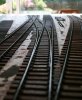
The photo above is the first which illustrates the curve of the Up Main and Down Main through the station throat... looking good to satisfy the reason for the build. At this time I am reminded of a contribution of our late Guv'nor, viz:-

I like the gentle curve :thumbs: Im really looking forward to seeing the track laying progress.

and regret that Cynric did not see how things developed.

regards, Graham
 

Steve Cook

Flying Squad
Great stuff Graham :)
Are 'we' going to be able to see the trackwork in the flesh so to speak? It looks like a work of art to me and I'd love to get a closer look.
Steve
 

Dog Star

Western Thunderer
Are 'we' going to be able to see the trackwork in the flesh so to speak?
Such a decision rests with the owner of the dream, John Lewsey. John has indicated that the layout ought to make at least one appearance at a S7 meeting, if so then I guess that invited guests might be possible.
 

Dog Star

Western Thunderer
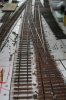
The diamond at the end of the down platforms has been there or thereabouts for some weeks and John has been wating patiently for a pikkie. The recent weather has mitigated against photography in natural light until today when we have had a warm day with sunshine - so we took the layout outside to try snapology on the recent trackwork. Humm, not as easy as I thought to take a decent photograph of the diamond (close to 25" overall length)... I need lessons from Heather.

So here is the best of the photos from today:-
complete-diamond.jpg

And yes, there are no check rails as yet - I aim to get the trackwork to a condition where the test wagon runs through switches and crossings smoothly without relying on the constraints of check rails. When stock negotiates crossings without bumps then I fit the check rails.

Work now moves to the underside of the baseboard where we face the challenge of wiring the diamond to work with either DCC or DC supplies.

regards, Graham
 

Scale7JB

Western Thunderer
During Pway building on Crosscombe Magna, we have learnt to rely on check rails as on the real thing, they make all the difference between working-ish and working well...

I wouldn't worry too much about making sure the Pway works without them...

JB.
 

Dog Star

Western Thunderer
Progress on the track for Hartley Hill had slowed for a while as I had been dealing with the Basingstoke Show and some necessary motor repairs. Rob Pulham has been pulling my leg about a serious lack of pikkies and John Lewsey has been advocating use of an I-pad to cover happenings.... sorry John, I have not got the hang of modern clicknology (I rely on my Kodak Box Brownie although 620 film is rather scarce now).

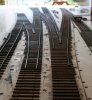
So what have we here today? Previous posts had been relating the construction of the diamond and the testing of track without check-rails - that position has been dealt with and is shown here. A milestone has been reached with the station board in that all of the common / obtuse crossings have been made and installed - the last two being the lead from Down Main to Down Loop (one crossing at 1:8 and one at 1:8.5). With the installation of the lead to the down platform loop work could continue with the down side carriage siding which is used for lay-by of terminating outer suburban services from Birmingham. The photos of the station area are facing down (from Birmingham towards Stafford, hence north), the down platform loop leads off to the left. The road through the diamond is a trailing connection from the Up Main to the Down platform road and is the means by which terminating services turnback to Birmingham.

The "dog-leg" on the far left track is the initial work on the trap for the exit from the carriage siding.
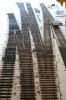
progress-1.jpg

progress-2.jpg

progress-3.jpg

In an odd sort of way the next photo records another milestone. This is the contents of an Exactoscale bag of 500 chairs... this is the third bag which means that I have used roughly 1000 chairs on the trackwork seen in the previous photos. Recent activity had exhausted the supply of pre-painted chairs so I made some tea and got painting. I have used Humbrol enamels 33, 1oo, 113 and 133 and mixed to produce "new rust" as befits track laid in the last couple of years (the Up Main and Down Main) - the ratio of one colour to another is varied as I progress so that there are several "rust-shades" in the pile of sprues. For info Rob, that pile represents about 5 hours work and three cups of tea.
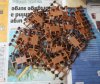
painted-chairs.jpg

Way back in this topic I showed the construction of a late Victorian turnout with an interesting feature of narrow chairs on wide timbers, as here:-
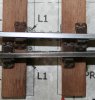
narrow chair.jpg

The turnout for the carriage siding is another part of the station area which is modelled in an old and decrepit manner so this turnout needs more of the narrow chairs, there are 24 of that type of chair per turnout. I make the narrow chairs by reducing the width of a standard plain line chair - load up a rail with standard chairs and then file the sides of each chair until the "narrowed" chair fits between the jaws of a vernier caliper (set at 4.2mm being half of the width of the 14" timber). This photo shows narrow chairs to the left and standard chairs to the right, producing the 24 chairs for the carriage siding turnout is about three hours work plus tea and tiffin.
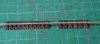
narrow-chairs.jpg

The reason that some of the turnouts are not finished is that the turnout toes are so close to the board join that I wish to lay the track over the join to the next board - a length of rail to include stock rail and plain line. By laying the track across the join I hope to maintain the "flow" of the curves without introducing dog-legs. When that happens I shall have to move the boards outside for the day and that may be a good opportunity for some better photography - I understand from the Chief Civil Engineer that a visit from the LWNR Photographer may be on the cards.

regards, Graham
 

SimonT

Western Thunderer
Nice to see progress, the track certainly flows.

5 hours work and three cups of tea
ONLY THREE? Standards man, minimum of a tea an hour, plus of course the obligatory Tiffin. "Oh no, not more Shorthouse"!
 
Top