

Heather Kay
Western Thunderer
Rather than clutter up my workshop threads with this, and while I wait patiently for paint to dry sufficiently for another coat, I thought I'd share my ad hoc paint shop.
I live in a 1960s bungalow, and Best Beloved converted the roof space into a modelling den many years before I met him. About five years ago, he comprehensively refitted it, reboarding the floor and installing shelves with workbench space above on three of the four available sides. Fluorescent tubes provide the main lighting. While it's insulated and has carpets, it does get hellishly chilly up there in the winter, so when I began to get busy building things I brought most of it downstairs. I now occupy part of the living room, with a large window and good north light, and - more importantly - ready access to the tea making facilities.
Of course, this meant the upstairs workshop wasn't being used to its best advantage. I persuaded BB that I could install a simple spray booth in one corner. As drapes, to block the area out and contain the worst of the overspray, I used those lightweight polythene sheets you can get in DIY stores. It's all held in place with duct tape. A plastic storage box is used for the actual spraying. It's large enough to get a 7mm coach in without hitting the sides.

Here you see the "booth". It is, by any standards, bodged together, though some thought went into its basic concepts. It's lit by a superannuated fluorescent desk lamp, which rests on the top of the plastic container, throwing a diffused daylight temperature light into the space I'm spraying in. For coach side spraying I have a cardboard box, wedged into the container, onto which I tape some cardboard angle pieces as ledges to support the sides. I don't know where these came from, but they were some form of packing material I think.
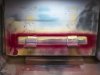
More duct tape holds the ledges in place. There's a block of 2x4 which wedges the box in place, allowing me to angle it back if I want. The block can be used to support work in its own right, and I also have various offcuts of foam packing and a cheap turntable affair for smaller items.
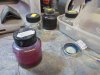
As I seem to be building batches of things these days, I have these large glass jars for mixing and holding paint. I like to have plenty of paint in hand for a job, and these 50ml containers let me mix more than I am likely to need. Once a job is completed, I tend to throw the remains out and clean the jar. I find my preferred thinners (bog standard white spirit) tends to separate from the paint over a 24 hour period, so if I'm not likely to need it again I chuck it out.
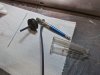
The trusty Badger 200. It's a single-action airbrush. I can't be doing with those fancy dual-action ones. I can't get my fingers round them. The nozzle where the needle allows you to adjust the spray pattern has worn, so it's pretty much one spray pattern these days. As a treat, I've got two new heads (fine and medium) and two new needles (fine and medium) on order, which should see the Badger give me a few more years of service.
You can see a glass syringe, which I use to decant thinners and paint into the glass jars. The jars themselves share a common thread to the suction doodad currently attached to the airbrush. This is the scene after a bout of spraying. I have removed the brush's needle, which has been carefully wiped down to remove any lingering paint, and I have also removed the head.
When a session is complete, I remove the paint jar and invert the airbrush while pressing the trigger. This clears paint remaining in the suction tube. I then fire clean thinners through, repeating the inversion until just air is running through the brush. Then it's disassembled until the next session. Once a full job has been completed, the airbrush is given a proper clean, but this interim cleaning operation keeps things running pretty smoothly between sessions.
The head unit is dunked into white spirit to prevent any remaining paint residue from drying in between sessions.

I've just commissioned this new compressor. I've had a Rötring compressor for donkey's years, and what a noisy, clattery machine it was. It still works, but we acquired this Clarke unit a couple of years ago. It was intended for an aborted pneumatic system or other, and has otherwise been idle. It's got a nice reservoir, and a quiet compressor pump which only kicks in when it's actually need to top up the reservoir. I can hear myself think, or the phone ringing, when using this machine.
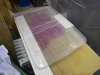
Finally, the Advanced Drying Facility. It's a couple of collapsable storage crates, filled with stuff that needs sorting, with a flattened cardboard box laid on top. Two lengths of what appears to be rectangular section downpipe act as supports for the dust cover (which is the lid from the storage box I spray into). In colder weather, the oil heater on the left is deployed to help the drying process. As you can see, I can get six 7mm scale coach sides under the cover at once.
I don't profess to be a skilled painter. I know my limitations, but this set-up works adequately enough. If I could find a way to reduce the amount of airborne dust, then I'd be a bit happier with it.
I live in a 1960s bungalow, and Best Beloved converted the roof space into a modelling den many years before I met him. About five years ago, he comprehensively refitted it, reboarding the floor and installing shelves with workbench space above on three of the four available sides. Fluorescent tubes provide the main lighting. While it's insulated and has carpets, it does get hellishly chilly up there in the winter, so when I began to get busy building things I brought most of it downstairs. I now occupy part of the living room, with a large window and good north light, and - more importantly - ready access to the tea making facilities.
Of course, this meant the upstairs workshop wasn't being used to its best advantage. I persuaded BB that I could install a simple spray booth in one corner. As drapes, to block the area out and contain the worst of the overspray, I used those lightweight polythene sheets you can get in DIY stores. It's all held in place with duct tape. A plastic storage box is used for the actual spraying. It's large enough to get a 7mm coach in without hitting the sides.
Here you see the "booth". It is, by any standards, bodged together, though some thought went into its basic concepts. It's lit by a superannuated fluorescent desk lamp, which rests on the top of the plastic container, throwing a diffused daylight temperature light into the space I'm spraying in. For coach side spraying I have a cardboard box, wedged into the container, onto which I tape some cardboard angle pieces as ledges to support the sides. I don't know where these came from, but they were some form of packing material I think.
More duct tape holds the ledges in place. There's a block of 2x4 which wedges the box in place, allowing me to angle it back if I want. The block can be used to support work in its own right, and I also have various offcuts of foam packing and a cheap turntable affair for smaller items.
As I seem to be building batches of things these days, I have these large glass jars for mixing and holding paint. I like to have plenty of paint in hand for a job, and these 50ml containers let me mix more than I am likely to need. Once a job is completed, I tend to throw the remains out and clean the jar. I find my preferred thinners (bog standard white spirit) tends to separate from the paint over a 24 hour period, so if I'm not likely to need it again I chuck it out.
The trusty Badger 200. It's a single-action airbrush. I can't be doing with those fancy dual-action ones. I can't get my fingers round them. The nozzle where the needle allows you to adjust the spray pattern has worn, so it's pretty much one spray pattern these days. As a treat, I've got two new heads (fine and medium) and two new needles (fine and medium) on order, which should see the Badger give me a few more years of service.
You can see a glass syringe, which I use to decant thinners and paint into the glass jars. The jars themselves share a common thread to the suction doodad currently attached to the airbrush. This is the scene after a bout of spraying. I have removed the brush's needle, which has been carefully wiped down to remove any lingering paint, and I have also removed the head.
When a session is complete, I remove the paint jar and invert the airbrush while pressing the trigger. This clears paint remaining in the suction tube. I then fire clean thinners through, repeating the inversion until just air is running through the brush. Then it's disassembled until the next session. Once a full job has been completed, the airbrush is given a proper clean, but this interim cleaning operation keeps things running pretty smoothly between sessions.
The head unit is dunked into white spirit to prevent any remaining paint residue from drying in between sessions.
I've just commissioned this new compressor. I've had a Rötring compressor for donkey's years, and what a noisy, clattery machine it was. It still works, but we acquired this Clarke unit a couple of years ago. It was intended for an aborted pneumatic system or other, and has otherwise been idle. It's got a nice reservoir, and a quiet compressor pump which only kicks in when it's actually need to top up the reservoir. I can hear myself think, or the phone ringing, when using this machine.
Finally, the Advanced Drying Facility. It's a couple of collapsable storage crates, filled with stuff that needs sorting, with a flattened cardboard box laid on top. Two lengths of what appears to be rectangular section downpipe act as supports for the dust cover (which is the lid from the storage box I spray into). In colder weather, the oil heater on the left is deployed to help the drying process. As you can see, I can get six 7mm scale coach sides under the cover at once.
I don't profess to be a skilled painter. I know my limitations, but this set-up works adequately enough. If I could find a way to reduce the amount of airborne dust, then I'd be a bit happier with it.


 )
)