Rivermead Central

40057

Western Thunderer
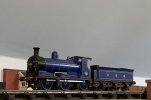
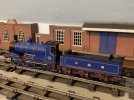
In post #620, I promised pictures of C.R. 828 on the layout ‘in due course’. Something else that has taken longer than intended. Anyway, here is 828 ‘at home’:

F1ADC1E4-79A1-4F1F-9A4D-FA8C33CAE3B4.jpeg

546FC4E0-F22C-44B4-9287-37597C0206CD.jpeg

A really lovely loco that I think looks completely in keeping with the vintage character of the layout.

And just to emphasise what a fine model it is, the front in close up:

D725273C-1EAC-4330-9794-BC0E7CAB6369.jpeg

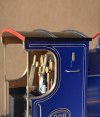
And the scale, working, cab controls:

ABA33EFE-2DCE-4088-9A5D-53F4DF88ED78.jpeg

For anyone who hasn’t seen this before, the build is described in Tom Mallard’s workbench thread.

Martin
 

John R Smith

Western Thunderer
Martin

828 is absolutely stunning, and you must be very proud. A gorgeous prototype, and brilliantly realised in O Gauge by Tom. The fact that it is spring drive just piles on the credit. Just one very slight doubt - how can your other engines possibly live up to this?

The tea billy in the cab is an inspired touch.

John
 

40057

Western Thunderer
Just one very slight doubt - how can your other engines possibly live up to this?

The tea billy in the cab is an inspired touch.

John
Hi John

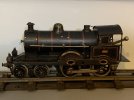
The level of detail on 828 was subject to much discussion with Tom during the build. The starting point was ‘hand-built Bassett-Lowke’ (i.e. Duchess, B17 etc.) with extras. Certainly, 828 is completely comparable in amount of detail with much Windsor Models production (though Tom’s workmanship is much better). We were also aware of this 1950s Beeson model of a very similar 652 class loco: James Beeson – 0 Gauge 0-6-0 Loco & Tender CR (Caledonian Railway) Class 652 No. 326, 3-rail electric | Vintage Hornby Trains

To accommodate the motor, the boiler of the Beeson model extends too far back into the cab. We reckoned if Beeson could do that, so could we. Which led to the decision to have a simplified but scale representation of the boiler back-head in 828. The tea and oil cans on the shelf in the cab are there to draw the eye away from the motor visible below. Your comment suggests that plan has worked!

The only other conspicuous addition to 828 compared with any other loco I have are the brakes. 828 has brake shoes and rigging. If you look at the photos above, I don’t think it would be instantly noticeable if the brake shoes were not there — especially since no other loco on Rivermead Central has them. However, given the detail above the platform, something more was needed lower down. The brake shoes are quite prominent in photos of the real loco and also help disguise the over-scale wheel flanges.

In respect of the cab detail and loco brakes, yes, 828 is a step up on anything else I have. Will it look out of place? I don’t think so. In fact, I’m sure not.

Martin

Edit on 13/7/26: There is I suppose really a third additional area of detail unique to 828 amongst my locomotives: a representation of the inside valve gear. I have several locomotives with full outside valve gear, but in a ‘traditional’ clockwork locomotive the mechanism occupies most or all of the space where inside valve gear would be. With 828, having carefully positioned the mechanism for maximum daylight under the boiler, adding a representation of inside valve gear followed logically.
 
Last edited:

40057

Western Thunderer
I have taken some more photos of 828 today, in better light:

EE041786-B6D6-47BE-BEEC-0F19CEE75DA3.jpeg

53E0E546-20B5-45A0-98D3-8459F1FC0346.jpeg

It is noteworthy that the clockwork motor, a bulky thing in relation to the really very small loco, is completely invisible.

In most of my photos, the background to the numberplate appears black or at least a darker colour than the side of the cab. The nameplate is in reality exactly the same colour. It does make me wonder about the interpretation of period photos of C.R. locos where the apparent different colour of the nameplate is often taken as indicating it is painted red.

Martin
 

John R Smith

Western Thunderer
That's a lovely paint job, Martin. The interpretation of period photos of locomotives is complicated by the likelihood that orthocromatic film may have been used, rather than panchromatic film, certainly before 1914. In which case reds will be rendered a darker shade of grey than they should be, orthochromatic film not being red sensitive. This actually simplified processing back then, as development could be done under red light, as B/W printing still is.


I don't know why Mike Delaney insists on referring to Mr Beeson as James, when just about everybody on the planet called him Stanley (including his wife!). The Beeson Class 652 is also a lovely model, and it is a tribute to Tom Mallard that his rendering gives nothing away to its predecessor.

John
 

40057

Western Thunderer
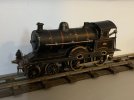
As per the discussion in posts #1,038 and #1,039, my Marklin Precursor:

ABC5FD29-3F69-4353-9DD5-225381C423D7.jpeg

996C1F75-957B-4978-AAF5-76B98AD064F0.jpeg

A truly ancient locomotive, getting on for 120 years old. Full credit to Marklin for such a good representation at such an early date. This was an entirely Marklin product, not commissioned by Bassett-Lowke, but was deemed good enough by B-L to include in the B-L catalogue. Built of heavy-gauge tinplate with brass fittings. Soldered construction and hand painted (including the nameplate). Large flanges to cope with small radius curves and tinplate track. Driving wheels much too small to give enough headroom for a good sized motor and large spring.

I will undertake the necessary conservation work in due course. Fit the replacement mechanism. And, in line with LNWR practice, 513 will emerge from works fitted with a different tender.

I still have some research to do regarding the tender. I am not sure what rear coupling Marklin would have used. Also, I don’t know if Bassett-Lowke would have fitted a different rear tender coupling to the models they retailed (see post #71).

Martin
 

40057

Western Thunderer
Having put up photos of 828 above, here is a rather different Scottish 0-6-0. An NBR ‘S’ class (= LNER J37):

981E8432-EF4C-4C5B-A2A9-15315809511C.jpeg

This is another ‘new build’ clockwork engine, completed in 2009. The builder was the late Brian Caton. Brian built the loco for me as a friend in tandem with a live steam version for himself. I did pay Brian for the build, but nowhere near a commercial rate. Brian died, far too young, some years ago now, but folk may remember his incredible 009 live steam locos which appeared at several exhibitions.

The bodywork of no. 292 is tinplate. The strength and rigidity of the material has allowed very thin gauge plate to be used, thus 292 is extraordinarily light compared with the weight of a typical clockwork loco. No suitable driving wheels were available so Brian made a pattern and had castings made. As it happens, the wheel diameter, number of spokes and crank position are the same for 828’s driving wheels as for 292 — and 828 also has wheels cast from Brian’s pattern. The tender wheels on both locos are old castings, I think Bond’s.

Brian’s metal working skills were outstanding. No. 292 is beautifully and accurately built; I can’t fault it.

The large-diameter high-pitched boiler of 292 has allowed a large motor to be used. A post-WW2 Bassett-Lowke 4-coupled mechanism is fitted, back-to-front compared with usual B-L practice, thus driving the rear wheels. The generous headroom provided by the size and pitch of the boiler meant there was no need to tilt the motor. The overhang of the motor beyond the driven axle did have to be shortened to fit in the cab and this was done in conjunction with fitting a Teleguv in place of the original governor. The powerful motor in combination with a light weight locomotive has resulted in an exceptionally strong engine for its size. I have had 292 pulling five coaches on a garden line, admittedly on modern nickel silver track with very large radius curves. The Teleguv has also resulted in a long run per wind and almost silent running.

For the record, the motor was rebuilt with a Teleguv by Paul Mason, clock maker. Diane Carney made the works and number plates.

Brian Caton also painted 292. Correct transfers for the tender were not available and Brian used the best he could find. These were garish and the company initials and numbers were both too large. I lived with the oversized lettering for a couple of years but then took 292 to Ian Rathbone and he hand painted the tender numbers and initials in the correct style. Ian also added some more lining which Brian had decided was too challenging. Ian’s hand-painted letters and numbers are superb and a massive improvement on the previous transfers:

7EF099CC-32B1-4FFF-988A-24C161F66004.jpeg

Note too the excellent finish produced by a thick coat of yacht varnish.

No. 292 is a superb loco and a great favourite.

The overall arrangement, a four-coupled motor driving the rear wheels, is the same in 292 and 828. In both cases, this has allowed daylight under the front part of the boiler. In both cases the motor projects into the cab. The NBR cab, with just a small side window, is of course much better at hiding the motor. The other advantage of the NBR design is the longer overhang behind the rear driving wheels which can accommodate the overhang of the motor.

As can be seen in the first photo, no. 292 has conventional cab control rods (i.e. rods with knobs on). The key hole on 292 is in a similar position to the key hole on 828, but without the benefit of a Westinghouse pump to disguise it. In line with Bassett-Lowke practice, 292 has no flanges on the middle driving wheels. Overall, 292 is thus a little more conventional than 828, but experience gained from 292 informed decisions during the building of 828. The Caledonian loco is inherently the more difficult design for a clockwork model, for several reasons. Less headroom for the drive spring (smaller diameter lower pitched boiler). An open cab making it hard to conceal if the motor projects into the cab. A very short overhang behind the rear driving wheels. The blue livery (any projection of the motor under the boiler in front of the firebox will be far less obvious in a black engine).

Martin

 
Last edited:

John R Smith

Western Thunderer
Martin

Absolutely stunniing. Many thanks for sharing. Ian's hand-painted tender artwork is extraordinary.

This engine and 828 perhaps suggest a debate about what do we actually mean by coarse scale? In both of these builds the only thing that I can see which is in any way "coarse" are the wheels (flanges, width and back to back). And even the wheels are nothing like as robust as a pre-1914 Bing locomotive, for example.

John
 

Ian@StEnochs

Western Thunderer
[QUOTE="John R Smith, post: 356093, member:

This engine and 828 perhaps suggest a debate about what do we actually mean by coarse scale? In both of these builds the only thing that I can see which is in any way "coarse" are the wheels (flanges, width and back to back). And even the wheels are nothing like as robust as a pre-1914 Bing locomotive, for example.

John
[/QUOTE]

Drop the word ‘scale’ and call it what it is, a model built to ‘0 gauge Coarse Standard’
 

Yorkshire Dave

Western Thunderer
I don't know why Mike Delaney insists on referring to Mr Beeson as James, when just about everybody on the planet called him Stanley (including his wife!).

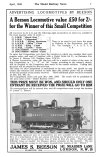
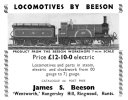
It'll be deference to the original advertising as seen the Brighton Toy and Model Museum. It appears he used his full name for formal and business use but his second name was used by family and friends. These advertisements are from 1933 and 1936 respectively. Category:James Stanley Beeson


760px-Beeson_locomotive_competition_(TMRN_1933-04).jpg
760px-Locomotives_by_Beeson,_Stirling_Single_(MEE_1936).jpg
 

John R Smith

Western Thunderer
Drop the word ‘scale’ and call it what it is, a model built to ‘0 gauge Coarse Standard’

Point taken, but that would be OK if there ever was in fact such a thing as "Coarse Standard" (and I don't count the 1960s O gauge Guild set of coarse standards as having much relevance, coming as it did virtually at the end of the coarse scale era). Before then, you could go from a pre-1914 track gauge of 35mm (measured from centre to centre of the tinplate railhead) and a variable B to B from as little as 26.5mm, to a gauge of 1 1/4 inches on solid brass rail in the 1920s and '30s and a B to B of 27mm (B-L standard), to post-1945 finer standard wheels with 28mm B to B (Exley and Jack Ray) and 32mm gauge.

We haven't actually asked Martin what wheel standards he has used for 292 and 828. This interests me, because the engines have to run on Lowko track.

John
 

40057

Western Thunderer
Responding to the discussion above.

First, the wheels. As John says, they have to run on Lowko Track.

For 292, the 27.0 mm back-to-back was regarded as sacrosanct. We reduced the B-L flange depth by 0.3 mm and the wheel width by 0.2 mm (= 5.8 mm instead of B-L’s 6.0 mm). There is no flexibility in the chassis, compensation or suspension. Testing suggested a slight refinement of the B-L wheel standard would still work. No. 292 has shown no tendency to derail. The reduced flanges mean it runs happily on modern Peco track (plain line, not points). But 292 will also run on Hornby round-headed tinplate track.

Learning from the above experience, 828 has slightly finer wheels again. Two changes were made to achieve that. First, Tom has built some flexibility into the chassis, so the leading and middle wheels can drop slightly. Effectively, this increases flange depth — so the actual flanges are 0.5 mm off the B-L standard. Then we pushed the back-to-back out to the tolerance limit for B-L track — 27.5 mm. This has allowed the wheel width to be slightly further reduced.

I don’t think wheel standards can go any finer if using B-L track standards. I don’t know the dimensions for B-L’s ‘Nu-scale’ wheels. But 828 must be pretty close to Nu-scale. We may actually have re-invented the wheel.

Now, ‘coarse scale’ or ‘coarse standard’. I agree the terminology is problematic. Apart from the wheels, there is nothing coarse about 292 or 828. Both are built to exactly correct scale dimensions with all parts in the correct proportion and position. They are exact scale models, but simplified. The key difference from a modern ‘fine scale’ model is not departure from scale, but less detail. Pipe work, rivet heads etc omitted, deliberately so. On 292 and 828, what’s there is right, but some things aren’t there. The exception is the wheels, which are ‘coarse’ — too wide and with large flanges relative to true scale. I haven’t measured this, but I suspect the wheels on 828 won’t be that different, proportionately, to the wheels on much current r-t-r 00 gauge production.

Since I’m on my soapbox, here’s another thing that really annoys me. Coarse scale/standard does not mean badly made or poor quality. A fine scale model can be clumsily constructed, joints not properly aligned, gaps between parts, right angles not right angles. That doesn’t make it ‘coarse scale’. It’s just not well made, crudely built. A ‘coarse scale’ model can still be a work of art. Craftsmanship of the highest quality. Beautifully built. Both 292 and 828 achieve these standards.

The problem, I think, is the word ‘coarse’ which can mean ‘large’, ‘rough’ or ‘lacking refinement’. In the context of a model locomotive, that could refer to the wheel flanges or the quality of construction. Often build quality and scale standards are conflated, but they really are two completely different things.

Before Brian Caton died, he and I had been discussing a possible Caledonian Railway 0-6-0. In anticipation of this project, I got a Bing motor (now in 828) rebuilt to suit. Then, tragically and unexpectedly, Brian became ill. Some years after Brian’s death, I started to make initial enquiries from scratch builders about the possibility of getting a C.R. locomotive built. I found builders who were keen to take on the project, but when I saw examples of their work it wasn’t good enough. I found builders who were producing outstanding models but who declined the commission when I explained the loco would be clockwork. There clearly was, quite generally, an assumption that ‘coarse scale’ meant ‘not very good’.

But fortunately I also asked Tom Mallard whose work is outstanding and who was keen to build 828.

Can we find another word — instead of ‘coarse’ — for less detailed models that cannot also be construed as meaning ‘crudely made’?

Martin
 

John R Smith

Western Thunderer
Hello Martin

Coarse scale/standard does not mean badly made or poor quality. A fine scale model can be clumsily constructed, joints not properly aligned, gaps between parts, right angles not right angles. That doesn’t make it ‘coarse scale’. It’s just not well made, crudely built. A ‘coarse scale’ model can still be a work of art. Craftsmanship of the highest quality. Beautifully built. Both 292 and 828 achieve these standards.

The problem, I think, is the word ‘coarse’ which can mean ‘large’, ‘rough’ or ‘lacking refinement’. In the context of a model locomotive, that could refer to the wheel flanges or the quality of construction. Often build quality and scale standards are conflated, but they really are two completely different things.

Hear, hear, to all that. Very well summed up.

I found builders who were keen to take on the project, but when I saw examples of their work it wasn’t good enough. I found builders who were producing outstanding models but who declined the commission when I explained the loco would be clockwork. There clearly was, quite generally, an assumption that ‘coarse scale’ meant ‘not very good’.

And once again we have the problem that railway modellers in general assume that "clockwork" equals "toy".

John
 

76043

Western Thunderer
Since I’m on my soapbox, here’s another thing that really annoys me. Coarse scale/standard does not mean badly made or poor quality. A fine scale model can be clumsily constructed, joints not properly aligned, gaps between parts, right angles not right angles. That doesn’t make it ‘coarse scale’. It’s just not well made, crudely built. A ‘coarse scale’ model can still be a work of art. Craftsmanship of the highest quality. Beautifully built. Both 292 and 828 achieve these standards.
Completely agree here.

But to answer the question, I think it is too late, but if I was going to offer a suggestion I'd say change Coarse to Original or date it by the year a standard could be considered to have been adopted.

Tony
 

Yorkshire Dave

Western Thunderer
After researching briefly, the term 'coarse' was originally used by the BRMSB in 1941 to classify the track and wheel standards up to the point where they defined track and wheel standards across the scales for railway modelling (generally ignored by manufacturers - roll on 85 years and today it's still the case in the UK).

It appears over time the term has unfortunately been diluted, taken out of context and generally misunderstood by many but not all railway modellers. Today the perception appears to be by association i.e. anything which runs on 'coarse' track must be coarse - which we know is not the case. In my view they are all models which are either designed to run on pre-WWII track standards or later fine scale track standards irrespective of fidelity to prototype, detail and propulsion method.
 

40057

Western Thunderer
After researching briefly, the term 'coarse' was originally used by the BRMSB in 1941 to classify the track and wheel standards up to the point where they defined track and wheel standards across the scales for railway modelling (generally ignored by manufacturers - roll on 85 years and today it's still the case in the UK).

It appears over time the term has unfortunately been diluted, taken out of context and generally misunderstood by many but not all railway modellers. Today the perception appears to be by association i.e. anything which runs on 'coarse' track must be coarse - which we know is not the case. In my view they are all models which are either designed to run on pre-WWII track standards or later fine scale track standards irrespective of fidelity to prototype, detail and propulsion method.
Thanks for looking into that!

I like your conclusion:

Models for pre-WW2 track standards
Models for modern track standards.

That’s a good distinction because it is the real difference. It also covers post-WW2 Bassett-Lowke production because the track and wheel standards were the same as before the War. Inherent in the classification by track type are the ‘other’ compromises that are common in models built for use on older track: bogie wheels too small, flangeless centre drivers etc that are necessary for very small radius curves. The distinction by track standard completely removes any conflation between type of model and quality of work.

In future, I might well refer to my models as you suggest.

Martin
 

John R Smith

Western Thunderer
Martin

That three-quarter view of 292 is glorious. The little handrail on the smokebox door catches my eye. Not knowing the prototype at all means that I am completely unaware of any missing details or rivets that you suggest may have been left out. You have managed to get an amazing amount of daylight below the boiler, so often a real problem with the B-L engines like the 4F.

Our discussion above got me thinking about my family's view of O Gauge back in the 1950s. My father was a very fine model engineer and also an accomplished railway modeller, in fact a leading light in the local club which had two extensive O gauge layouts, one indoors and one outdoors. As far as he was concerned there was tinplate (by which he meant Hornby on the carpet), O Gauge (which was basically Bassett-Lowke, Leeds, Milbro etc), and finescale, a term which he applied only to those wheels which would not run properly on the club track. I don't remember him ever using the term "coarse scale".

At that time (say the mid 1950s) I had never seen an example of finescale O gauge except for one GWR coach at the club. This was an object of contempt and derision from the clockwork and live steam gang, as it refused to run through our points and always fell off the track (no wonder, with 29mm B to B). Otherwise, my first awareness of finescale was the amazing feature on W S Norris' layout in the MRN for June 1957 (p143 et seq). Inspirational as it was, it in most respects seemed irrelevant to our efforts. But I suppose this was the moment that I began to view what had hitherto just been standard scale O gauge as "coarse" rather than "fine". In retrospect, it now does seem most unfortunate that those terms (fine and coarse) were adopted, with their somewhat judgemental implications.

John
 
Last edited:
Top