Yorky D's Küchentisch: Two into One...!

Yorkshire Dave

Western Thunderer
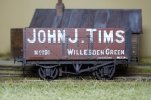
I've had a second attempt at hand lettering a wagon for a coal merchant on the Met. Close up it looks pretty grim but from 50cm to 1m it looks ok.
DSCF5926.jpg

This time it is on a Slaters 7 plank end door wagon which was easier to work on as the sides were painted and lettered before assembly. The italic Load 10 Tons and MET. RLY. being from decals and lettering I have kicking around.

I need to find some italic Tare lettering and numbers for the tare weight on the lower plank under the running number but I begrudge paying a tenner for a sheet of decals for two words, six numbers and four dashes/full stops.

The keen-eyed will note this is a Charles Roberts 7 plank end door wagon whereas it should be a Gloucester 7 plank end door wagon. I could not find a kit of the latter with a 16' body which means the underframe will receive some attention in due course to bring it closer to the Gloucester type.
 
Southern

Yorkshire Dave

Western Thunderer
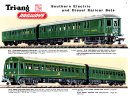
While visiting the Vintage Carriage Trust's bookshop at Ingrow among some books I purchased I also acquired a late 1950s early 1960s Tri-ang Southern suburban EMU for a song. Catalogue picture below.

The unit itself follows no prototype but is an adaptation of Tri-ang's late 1950's interpretation of Mk1 coaches. The bodysides have a continuous curve and droplights. The EMU cab is a cross between the original LSWR torpedo and SR 1925 EMU stock, however it does look the part.
Triang 006.jpg

It comprised of a powered driving brake third, two intermediate coaches and a dummy driving brake third. Three of the vehicles were of late 1950s and one intermediate coach of 1960s vintage. I didn't use the coach below as the pervious owner(s) had damaged this side attempting to take the roof off.

Triang 03.jpg

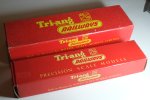
Also two boxes were supplied.

Triang 02.jpg

The box for the powered driving brake third also contained it's original small bottle of Shell oil

Triang 01.jpg

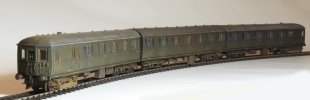
I modernised the unit for a bit of fun whilst retaining the body shells, roofs and underframes. It utilises the latest Hornby SR EMU 8'9'' drive and SR 8' steam bogies, Southeastern Finecast flush glazing and Symoba close coupling units between the set. It received a repaint into SR olive and decals added and as mentioned earlier it is not a model of any 3-SUB prototype.

Triang 005.jpg


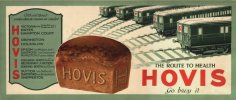
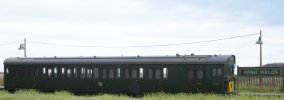
Alas, I do not have enough of these nor a loaf of bread to recreate the famous advertisement but managed the below by merging multiple exposures.
HOVIS 001.jpg
Hovis 3SUB.jpg
 

Yorkshire Dave

Western Thunderer
I picked this pair of EFE Bristol RE LL single decker buses for a tenner each with the aim of converting one of them into a dual door variant as used by Luton Corporation Transport prior to 1970 when they were taken over by United Counties. EFE do not produce a dual door version.

I vaguely recall these in the late 1960s when we used to come over from Germany to visit my grandparents in Dunstable.

Model 3.jpg

The models were taken apart, the bodies stripped down and the door removed from the later curved windscreen variant and inserted into earlier flat windscreen variant.
Model 2.jpg

Then the centre pillar of each four-leaf bi-fold door was removed to create two pairs of bi-leaf doors as fitted to the Luton Corporation Transport variants.
Model 1.jpg

I also started work on a Britbus Park Royal bodied AN68 Leyland Atlantean as used by London Country. Ala it suffered from Zinc Rot/Zinc Pest/Mazak Rot. You would have thought with today's technology, manufacturing processes and quality control this would be a thing of the past but unfortunately alloy batches still get contaminated in the die cast world. There are known models produced recently that are affected by Zinc Rot - including model railway locomotive chassis.
Model 4.jpg

When it comes to buses, modelling a London Transport/London Country fleet is a lot easier than a provincial fleet due to LT's standardisation - the main area of research here is the correct garage code and the bus type for the route chosen for the time period portrayed.

Provincial fleets tended to buy their buses in smaller batches with each batch having a subtle variation. Like any modelling, photos are paramount for the year portrayed. A good example is the Bristol VR double decker with their windscreens, radiators and position of the rear engine air intakes. You can easily have a Series II version modified with a Series III curved windscreen but retaining the series II engine air intakes.

All good fun. :)
 
Top