Fordwich Arms

Willl

Western Thunderer
Although I’ve not been lacking for broader modelling motivation as of late, successful layout ideas have proved a bit of a sticking point. Rye Sands (and Pattyndenne before) felt easy to plan and build as the inspiration was strong and I had a very clear image of what I wanted right from the start. However, attempts at a layout plan since, despite having promise, have become bogged down either due to me not being able to decide what I want to make feeling overwhelmed by the volume and complexity of work required to get going.

One idea that did get some traction was for a cameo layout inspired by the contractor’s lines used for the construction of the tube (or other cut-and-cover lines). I feel this idea has potential, but it is dependent on a number of items of stock which I won’t have built for some time… and then there’s all the buildings that will have to be made for the urban scene to feel convincing. As such, t’s unlikely to deliver quick results.
I spotted in the last few days that Peco has announced a competition for Rail200 to build a scene on a specified 750x300mm baseboard. Whilst I’m not particularly interested in the competitive aspect, there are two key aspects of the contest that are appealing:
  • Time bound - entries must be finished by 30th September, so scope creep isn’t really an option!
  • The rules dictate that the scene cannot be larger than the 750x305mm board, so I’ll have to make things fit rather than giving in to the aforementioned scope creep!
This has led to the sudden creation of a new scheme. In a way, this reflects a return to the layouts I have historically loved most, going against my growing urge to try and do things that are new, unique, or challenging. This is probably the first plan I’ve had in 6 months which strikes the balance of being both achievable and exciting. The basic idea is this:

Until the 1820s, the city of Canterbury’s main trade route was via the outmoded river port at Fordwich. This led to a number of proposals for canals or waterways to link Canterbury to the sea at Faversham, and ultimately prompted the creation of the South’s first (and depending on the definition the world’s first) public railway (with a scheduled service yada yada) in the Canterbury and Whitstable.

Fordwich Arms imagines that, instead of the port at Fordwich being abandoned, it was connected to the C&W via a spur. As with the C&W, the line was subject to height restrictions, due to the need for trains to run under the medieval bridge at Fordwich Quay. The line never lived up to the promoters’ aspirations, due to the gradual silting up of the Stour, and was on the brink of dereliction long before the grouping. Nevertheless, a small number of private traders kept operations running, although demand rarely called for more than a few elderly South Eastern wagons.


Fordwich Arms unsurprisingly takes its name from the village pub, although the real building won’t fit! Given the space constraints, it’s likely to be little more than two turnouts, with facilities for a traverser. Given the maximum height of the Rail200 entries is 140mm, I’ve opted to go without a backscene (at least until the competition is over), and am instead aiming to use the scenic features as a natural view block. Think tall pines and oaks at the back, the ancient bridge on the right, and perhaps the town hall at the left hand end.

I’ve had a quick play with Fusion 360 to see if the layout will work - this was definitely beneficial as I’d grossly underestimated the space constraints until I put a 3D model of one of my wagons on! It’ll likely be a few weeks until I have anything concrete to show, but I’m looking forward to getting started.

1744483626746.jpeg


1744483893783.png

Will
 

simond

Western Thunderer
it’s been a while since I visited Fordwich but there was a decent pub, and a very expensive restaurant. (And Canterbury MES track is just down the road)

We had a “special occasion” dinner in said restaurant with the kids one night maybe 15 years ago. On getting in the taxi I remarked that the bloke on the table next to me was probably a drug dealer. My lad said I shouldn’t make such awful assumptions based on appearances. I pointed out that said bloke had just paid the thick end of £400 for dinner in cash…

Anyway, there’s also some lovely architecture and a very pretty stone bridge over the Stour.

Challenging given your space constraints
 
Last edited:

Willl

Western Thunderer
it’s been a while since I visited Fordwich but there was a decent pub, and a very expensive restaurant. (And Canterbury MES track is just down the road)

We had a “special occasion” dinner in said restaurant with the kids one night maybe 15 years ago. On getting in the taxi I remarked that the bloke on the table next to me was probably a drug dealer. My lad said I shouldn’t make such awful assumptions based on appearances. I pointed out that said bloke had just paid the thick end of £400 for dinner in cash…

Anyway, there’s also some lovely architecture and a very pretty stone bridge over the Stour.

Challenging given your space constraints

Challenging is definitely the word. Less will definitely be more but the bridge, wooden crane and the adjacent timber shed are the must haves, but the town hall and ground frame are optional. What isn't clear from the track plan is that the points are both small radius - even then the sidings are comically short!

On second thought, maybe I should just call it Fordwich... I failed to consider that the pub still exists!

Will
 

Willl

Western Thunderer
Will, I am building a layout with much the same track plan in a length of 2 metres in 0-F.

If you can find/make some stock in the time available, the 750mm space would be a way to showcase 1:55 scale narrow gauge. The 5.5mm Association has a web site at 5.5mm Association - the ideal narrow gauge scale.

I had actually considered narrow gauge, likely 009 in light of the easy availability of 3D printed stock (in keeping with the ’quick and easy’ approach to the challenge). In the end I keep coming back to SER/SECR, plus I thought the setting would also be quite suitable for small industrials or my Rapido J70. In some ways the riverside setting is quite Wisbech & Upwell.

For those not familiar with the real place (I wasn’t until a week or two ago), these photos give a flavour of the place. The wooden shed in both photos and the large Tudor hall in the top image are both intended to be modelled, and are reflected in the CAD drawing (measurements are approximated but I will try and visit the real place in time)


IMG_2089.jpeg

IMG_2075.jpeg
 

Joe1980

Western Thunderer
This looks like a great plan. I saw the competition advertised in Railway Modeller and was contemplating an entry too (not that I expect to win). I think the idea of it being quite self contained and time bound definitely makes it appealing.
 

RichardG

Western Thunderer
After I built my layout I extended the headshunt so it was long enough to take two wagons and the loco. This has made operating that bit more flexible. Also, the kickback siding is long enough to take two wagons.

If you are planning on doing towing ("rope shunting") then paying some attention to the frog power will help. Because you will probably find yourself moving point blades when a loco is already on the turnout. If I was building this in 00 I would look for Peco points with a Unifrog, and leave the frogs unconnected.

Hope this helps.
 

40057

Western Thunderer
… even then the sidings are comically short!
I suppose that is inevitable given the limit on overall size. But it is so unlike nearly all real railways. Of course, there are unusual, constrained layouts in industrial/urban settings etc., but generally railways have long sidings and loops in big spaces. I sometimes think folk (not you, clearly) miss that realism has to apply at different scales. By ‘scale’ I mean extent, size. Is this rivet correctly portrayed (size, shape)? Is this vehicle correctly portrayed? Using modern models, generally, yes. But is this track layout realistic? Err … often no, not at all. Curiously (I find it so, anyway), at normal viewing distances for a layout, it really doesn’t matter if the rivet is accurately portrayed. Some compromises and simplifications in the portrayal of the vehicle won’t show either. But often great effort is taken to get these things exactly correct. Having done that, at the scale of normal viewing, the ‘model railway’ type track layout is painfully obvious and there is no way of covering that up.
 
Last edited:

Willl

Western Thunderer
I suppose that is inevitable given the limit on overall size. But it is so unlike nearly all real railways. Of course, there are unusual, constrained layouts in industrial/urban settings etc., but generally railways have long sidings and loops in big spaces. I sometimes think folk (not you, clearly) miss that realism has to apply at different scales. By ‘scale’ I mean extent, size. Is this rivet correctly portrayed (size, shape)? Is this vehicle correctly portrayed? Using modern models, generally, yes. But is this track layout realistic? Err … often no, not at all. Curiously (I find it so, anyway), at normal viewing distances for a layout, it really doesn’t matter if the rivet is accurately portrayed. Some compromises and simplifications in the portrayal of the vehicle won’t show either. But often great effort is taken to get these things exactly correct. Having done that, at the scale of normal viewing, the ‘model railway’ type track layout is painfully obvious and there is no way of covering that up.

The harsh reality is that most people have more control over the level of detail they apply to individual items of stock than they do over the amount of space they have for layouts.

Yes, having mile long passing loops is more realistic, but they're not any more interesting to look at or operate than a short loop. Ultimately I care more about making something I find interesting than perfectly recreating a prototype.

My layouts are all built with the intention that they should be viewed at eye level, and from a short distance, so you can only see part of the scene at a time. This goes some way to forgiving the compromises made due to the lack of space.

I think railway modellers as a collective are perhaps too literal in our approach. Military dioramas, for example, don't recreate a whole battle in perfect accuracy - they're more about evoking a sense of the place and event. It may not be for everyone, but this is what I'd like to do with Fordwich. There was no railway there anyway, so there is no prototype!

Will
 
Last edited:

Flaxfield

Western Thunderer
The harsh reality is that most people have more control over the level of detail they apply to individual items of stock than they do over the amount of space they have for layouts.

Yes, having mile long passing loops is more realistic, but they're not any more interesting to look at or operate than a short loop. Ultimately I care more about making something I find interesting than perfectly recreating a prototype.

My layouts are all built with the intention that they should be viewed at eye level, and from a short distance, so you can only see part of the scene at a time. This goes some way to forgiving the compromises made due to the lack of space.

I think railway modellers as a collective are perhaps too literal in our approach. Military dioramas, for example, don't recreate a whole battle in perfect accuracy - they're more about evoking a sense of the place and event. It may not be for everyone, but this is what I'd like to do with Fordwich. There was no railway there anyway, so there is no prototype!

Will

Spot on Will.

Those who build larger layouts often miss the point a small layout makes, and the accompanying compromise required. Our type of small, Cameoesque style layouts are nothing more that enlarged dioramas which simply seek to capture the essence of, rather than faithfully depict, if that makes sense. If truth be told, I prefer the challenge that capturing that essence in such a small space presents.

Your reference to military dioramas is a correct comparison and I maintain railway modellers could learn much from our military modelling chums, not only in terms of techniques but also in the focus required to produce a successful composition.

Rob
 

Willl

Western Thunderer
Trouble is, I do like big locos and long trains...

But I don't like the budget they imply!

Even small shunters can require a big layout when you have as many as I do...

I always used to long for huge roundy roundy layouts, and my first cameo (Pattyndenne) was just a stop gap before re-doing my larger circular layout. The cameo bug then bit, the larger layout was taken apart, and the rest is history.

I'm hoping to get the board built and track laid this weekend. I have a stalled layout project which will likely act as a donor for the pointwork, although I always feel a little uneasy taking apart an unfinished project, given the slim chance I could actually regain enthusiasm for it. It has been over a year since I've touched this one though, so I think the time has come.

Will
 

Willl

Western Thunderer
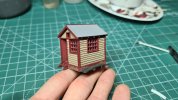
Fordwich is progressing slowly (by my standards) but a few of the buildings are done. The ground frame is a Rail Model kit, not right for SER/SECR but I liked the design. Now it's done I'm not 100% convinced, so I may end up making a new one to a SER design. It's actually been weathered now, but I don't have any photos of that

20250423_223106.jpg

I've also renumbered a Hornby peckett B2 into a faux SECR livery. Again, completely unprototypical, but it looks right and I like it! It'll go very nicely both on this and Rye Sands

20250430_215949.jpg

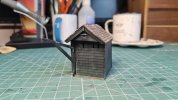
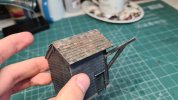
The most recent job has been the crane house. This was what originally drew me to Fordwich, so it was something I was keen to replicate. I'm very pleased with how it's come out, in particular the weathering. I've tried to replicate bird muck, collecting on any horizontal surfaces and around the small holes in the peak of the roof.

20250507_184038.jpg20250507_184014.jpg

20250507_184012.jpg


20250507_184023.jpg


20250507_184014.jpg


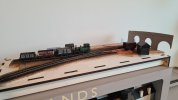
So here's how things now stand

20250507_184501.jpg

The next job will be the medieval bridge, the other centre piece of the layout. I'm not sure how best to tackle this, but may try carving some blue/XPS foam as I've seen good things from military modellers who have used it .

Will
 

Attachments

  • 20250507_184026.jpg
    20250507_184026.jpg
    191.9 KB · Views: 9

Willl

Western Thunderer
Love the crane house Will. Small buildings can have so much character!

Thanks Andy! It's a really charming little building, and basically single handily inspired this whole layout scheme.

I've made a start on the medieval bridge. I'm slightyl unsure how best to approach adding stone texture. The inside of the arches are pretty tightly curved, so I don't fancy using embossed plasticard on them (plus I've deliberately made the arch that the track goes through extremely tight, to further emphasise that the bridge significantly pre-dates the railway. This means DAS clay isn't really an option). I think I may end up scribing it all, joy of joys!

20250508_201836.jpg
 
Top