
You are using an out of date browser. It may not display this or other websites correctly.
You should upgrade or use an alternative browser.
You should upgrade or use an alternative browser.
7mm Llanbister Rd. via Bleddfa.........
- Thread starter Geoff
- Start date


Pencarrow
Western Thunderer
Me use AI!!
The shed is still under construction, Alan and is roughly 50% complete.
View attachment 258592
Ade is spot on Alan, and there is no AI trickery involved, the only thing I can do with AI is to turn it off!
Geoff.


Looking very good Geoff.
I know many folk think it's madness to individually add bits of plasticard for each 'stone' but... It does end up being quicker than you think and I do think the result is well worth the effort. Plus you have a finish that's unique and doesn't look like one of the few stone finishes.

James
Western Thunderer
I added all the stones on one building for the NRM individually and it was surprisingly quick - quite relaxing too!Looking very good Geoff.
I know many folk think it's madness to individually add bits of plasticard for each 'stone' but... It does end up being quicker than you think and I do think the result is well worth the effort. Plus you have a finish that's unique and doesn't look like one of the few stone finishes.
Pencarrow
Western Thunderer
I added all the stones on one building for the NRM individually and it was surprisingly quick - quite relaxing too!
Almost like building a wall...
I used the Iliffe Stokes method 60 years ago with 'chads' of cardboard respresenting stone blocks, their thickness varied by carefully peeling away one or more of the layers of the card. It was surprisingly quick once the 'stones' were prepared and cut to different sizes. The surface needed sealing with shellac or varnish to stop the card from absorbing paint. It was also a great deal easier on the lungs than scribing DAS.

Geoff
Western Thunderer
Looking very good Geoff.
I know many folk think it's madness to individually add bits of plasticard for each 'stone' but... It does end up being quicker than you think and I do think the result is well worth the effort. Plus you have a finish that's unique and doesn't look like one of the few stone finishes.
Thanks Chris,
It is worth the effort to produce a finish that is unique and looks better than any embossed or moulded sheet. I just added a couple of courses in odd moments, we get a lot of those in this house, so it didn't take long to complete the first three walls.
I added all the stones on one building for the NRM individually and it was surprisingly quick - quite relaxing too!
I'm also finding it to be relaxing, James. I get the feeling that I'm really building something in the same way as I do when constructing track.
I used the Iliffe Stokes method 60 years ago with 'chads' of cardboard respresenting stone blocks, their thickness varied by carefully peeling away one or more of the layers of the card. It was surprisingly quick once the 'stones' were prepared and cut to different sizes. The surface needed sealing with shellac or varnish to stop the card from absorbing paint. It was also a great deal easier on the lungs than scribing DAS.
You beat me to it by mentioning chads sir!!
 The late Bob Barlow and Iain Rice inspired me to create brickwork using those in 4mm scale. I doubt that they will be easy to come by these days with the demise of punch cards, though I stand corrected. DAS has its uses, but it's hard work scribing stones into large surfaces.
Geoff.
Pencarrow
Western Thunderer
I know a lot of the war gaming and military modelling fraternity scribe and emboss finishes into a foam-like material. It seems to get results very quickly and, done well, can look very very convincing.
My main concern with that approach is that if something is very easily scribed then it's also very easily damaged. Not a problem if put on a layout and never touched or gone near again but... Having at first hand seen what layouts have to go through when exhibited, I would always worry that the exquisite finish could be trashed in seconds.
I have used DAS before too, quite a lot on my 4mm clay branch layout Polsarrett. I quite like it, particularly the stone effect variety they make. I don't think it's any quicker or easier than my other plasticard based methods though.
What I always try and aim for is a finish that doesn't look like sheets straight out of a pack and stuck to a model. My pet hate is to see buildings and structures with no attempt to hide sheet or corner joints. (That's a particularly a problem with the same Wills sheets IMO). As soon as you see the sheet, you've destroyed the realism.
On the other hand, I really like and appreciate work such as that done by Geoff a few posts earlier.
My main concern with that approach is that if something is very easily scribed then it's also very easily damaged. Not a problem if put on a layout and never touched or gone near again but... Having at first hand seen what layouts have to go through when exhibited, I would always worry that the exquisite finish could be trashed in seconds.
I have used DAS before too, quite a lot on my 4mm clay branch layout Polsarrett. I quite like it, particularly the stone effect variety they make. I don't think it's any quicker or easier than my other plasticard based methods though.
What I always try and aim for is a finish that doesn't look like sheets straight out of a pack and stuck to a model. My pet hate is to see buildings and structures with no attempt to hide sheet or corner joints. (That's a particularly a problem with the same Wills sheets IMO). As soon as you see the sheet, you've destroyed the realism.
On the other hand, I really like and appreciate work such as that done by Geoff a few posts earlier.
Geoff
Western Thunderer
I assume that you are referring to foamboard, Chris? The softer boards as sold in Hobbycraft and those used for food packaging are easily damaged. However, better quality boards such as 'Palight' are much firmer and feel like styrene sheet. I used some to construct my 4mm engine shed, scribing the stonework into its surface with a blunt ballpoint pen. Care has to be taken to keep any exposed edges away from solvents though..

Geoff.
Geoff.
Pencarrow
Western Thunderer
I assume that you are referring to foamboard, Chris? The softer boards as sold in Hobbycraft and those used for food packaging are easily damaged. However, better quality boards such as 'Palight' are much firmer and feel like styrene sheet. I used some to construct my 4mm engine shed, scribing the stonework into its surface with a blunt ballpoint pen. Care has to be taken to keep any exposed edges away from solvents though..
View attachment 258704
Geoff.
Thanks Geoff. I suspect asking me to keep solvents away from a build is asking for trouble.

Geoff
Western Thunderer
My Llanbister Road shed project is now well underway, two of the old Bleddfa Road baseboards were stripped of track, and some of the scenery was salvaged in hope of using it again as a base for the new terrain. The whole diorama measures 7ft 9 in x 14 in and is on a gentle arc along one wall of my modelling room. I plan on making a few changes to the backscene once I've made my mind up about the scenery, some of which has been blended together using my photo editing software to try various ideas.
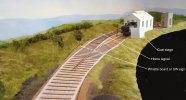
At the moment the coal stage is just a simple styrene shell, I'm not sure if the old water tower will survive, but in saying that, it does provide an effective view blocker. The 1.5 mm sleepers and timbers are Slater's, and I'll be using their rail as well, with Exactoscale 2-bolt GWR chairs. The whole scene is loosely based on Kington Shed with a touch of modellers' licence.
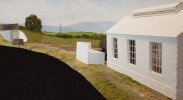
In my imaginary world the Lugg Valley Railway joins the Central Wales Line beyond the overbridge at Llanbister Road Junction station, which will be nothing more than a couple of removable storage sidings. The bridge itself will have the same stone finish as the engine shed, as will the coal stage. You may ask, 'What's the point of it all?' Well, I just liked the idea of modelling a rural engine shed where a couple of my locomotives could be displayed. However, trains will be able to pass through the scene should I wish.
Geoff.

Captain Kernow
Western Thunderer
All looking very promising, Geoff. Have you seen this, by the way? - Lightmoor Press Books - Branch Lines to Leominster and Kington