
You are using an out of date browser. It may not display this or other websites correctly.
You should upgrade or use an alternative browser.
You should upgrade or use an alternative browser.
7mm Llanbister Rd. Shed.
- Thread starter Geoff
- Start date

Geoff
Western Thunderer
Since moving the platelayers hut across the track, I've been pondering what to do with the empty space left behind. After thumbing through various photo albums for inspiration, I came across a photo of an ex GWR lamp hut. Nothing remarkable in that, but this example had been painted black with a dark stone door. Evidence of rust was plain to see on all the panels, so I thought a model of that will do just fine.

The kit is by Intentio, and very nice it is too, I painted it with a mix of Lifecolor weathered, and dirty black, with a touch of burnt rubber, and dark rust shadow. The whole lot was then blended together with a dusting of Carrs light rust weathering powder. The next jobs involve modelling some Rosebay willow herb plants and a spoil heap.

Geoff
The kit is by Intentio, and very nice it is too, I painted it with a mix of Lifecolor weathered, and dirty black, with a touch of burnt rubber, and dark rust shadow. The whole lot was then blended together with a dusting of Carrs light rust weathering powder. The next jobs involve modelling some Rosebay willow herb plants and a spoil heap.
Geoff


Geoff
Western Thunderer
Thanks chaps,
I've got used to it over the years Paul, and suggest that they pay a visit to Specsavers
Geoff
Do you find it a bit unnerving that people keep calling you beautiful Geoff ?
Your scenic work is very nice by the way
I've got used to it over the years Paul, and suggest that they pay a visit to Specsavers
Geoff


James
Western Thunderer
and suggest that they pay a visit to Specsavers
As it happens I am due an eye test...

Geoff
Western Thunderer
As it happens I am due an eye test...
Judging by the quality of your modelling James, I would say that your eyes are fine.

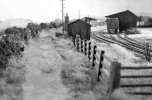
the b and w photos make it real
Thank you, there is a letter in the latest issue of MRJ on the very subject. B&W makes for a realistic and an atmospheric photo, but it's always good to have a colour reference as well.
Sorry, for borrowing your photo and turning it black & White, but this isBeautifulOutstanding, sensational, top-notch, awesome, you get the drift.
No worries Gary, I like what you did there with the crossed out word
 Incidentally I take every photo in both B&W and colour, so I could have saved you the trouble of converting that one
Geoff

James
Western Thunderer
Judging by the quality of your modelling James, I would say that your eyes are fine.
That's very kind of you to say so
Geoff
Western Thunderer
Nice job on the corrugated lamp hut. The Intentio kit is a good one.
Thanks Larry, it is indeed a good kit, though my wife thought it was something else when she said, "That's a nice little Shepherds hut"


I've been experimenting with making some wild flowers and weeds, Barry Norman style, though my first effort looks like a bouquet of flowers.

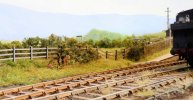
I was only half mad when I started off with this project, plenty more to plant yet, but if you think they look crap then please say so.
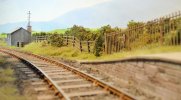

Finally one for the black and white brigade....
Geoff
Last edited:
Regarding your plants, since you ask for frank comment, what are they meant to be?Thanks Larry, it is indeed a good kit, though my wife thought it was something else when she said, "That's a nice little Shepards hut"
View attachment 241098
I've been experimenting with making some wild flowers and weeds, Barry Norman style, though my first effort looks like a bouquet of flowers.
View attachment 241099
View attachment 241100
I was only half mad when I started off with this project, plenty more to plant yet, but if you think they look crap then please say so.
View attachment 241101
View attachment 241102
Finally one for the black and white brigade....
Geoff
I have done quite a bit of botanical survey work in my time and I don’t recognise them!
There aren’t that many species of wild plant likely to be found on a railway embankment/verge. That number will be fewer again if, say, the underlying geology means there is a particularly acid soil. So the choice of plants to be represented really should be appropriate to the site and species that would be found together, in similar conditions. Otherwise it’s like sticking a GER signal in an LSWR station.
PS I should say, I think your layout is great. I will also say getting vegetation right is difficult. I would go out and photograph a real grassy bank, take a good look at what’s growing there and try to reproduce the appearance.
Last edited:

Paul Tomlinson
Western Thunderer
Hello Geoff, just noticed the "Public Footpath" sign. Scarcely noticeable, but every little detail like that adds to the realism you skillfully create. I admit to not being a great fan of the new wildflowers - they seem to be too multicoloured and lack your usual subtlety. Walking up the lanes here, we are lucky to see a variety of wildflowers, but they come and go with the seasons, and I'd say the flowers are generally less than an inch in diameter. The same colour tends to appear in a low-lying group - blue, yellow or white, with the odd pink campion. The new fence I do like. All the best.
Last edited:
Geoff
Western Thunderer
Thanks for being so honest and helpful about the wildflowers guys and for your kind comments, it took only minutes to remove the offending items and consign them to the bin. I've since been reading Gordon Gravetts account of modelling Rosebay Willowherb, Buddleia and Nettles. So it's back to the drawing board and then I'll try again.
Geoff
Geoff

Richard
Western Thunderer
Since my next model might well include a herd of cows, I'd appreciate your input on how to generate realistic cow pats without using something drastic like compressed guinea pig droppings!'as only half mad when I started off with this project, plenty more to plant yet, but if you think they look crap then please say so.'
GeoffThanks for being so honest and helpful about the wildflowers guys and for your kind comments, it took only minutes to remove the offending items and consign them to the bin. I've since been reading Gordon Gravetts account of modelling Rosebay Willowherb, Buddleia and Nettles. So it's back to the drawing board and then I'll try again.
Geoff
I would say your existing vegetation looks excellent, very convincing.
If you want to go a bit further — take care! It’s not just about making a convincing representation of a particular plant species. The plants found growing together (‘plant community’) are not random assemblages. So even if all your individual plants are great models, if you mix species from different habitats, soil types etc, your vegetation will not be realistic.
I don’t want to over-complicate this for you, so please feel free to ignore the following.
But I wouldn’t start by choosing some plant species to model. I would start by choosing the type of vegetation. Then model examples of the species found in it.
Your grassy bank, for instance. It’s not grazed by stock, probably not cut either — so unmanaged. Lowland with probably a pretty fertile soil, approx. neutral pH or limey. I would expect a grassland dominated by false oat grass —Mesotrophic Grassland 1 (‘MG1’) in the National Vegetation Classification. This is a very common vegetation type widely found nowadays on road verges. It’s probably a lot more common than it used to be, since horses stopped being generally used for transport and road verges are thus usually not now grazed. MG1 is even described by Shakespeare in Henry V when the Duke of Burgundy laments the changes to the French countryside due to neglect on account of the war.
So a tall (in summer) grassland when the grasses are flowering. As there is no grazing or mowing, an accumulation of grass leaf litter on the ground. Few low growing plants present in consequence. False oat grass and other grasses such as timothy, Yorkshire fog, perhaps couch. Also tussock-forming grasses, especially cock’s-foot. Some broadleaves — species than can grow to a similar height to the grasses such as ox-eye daisy, hardheads, maybe campions (note these have different flowering seasons). Also species that can raise their leaves in the canopy by using other plants for support — vetches, meadow vetchling, hairy birds-foot trefoil (on wetter sites or in the west). Don’t overdo the broad-leaves; false-oat dominated grasslands can be very species poor.
As I say, I think what you have is excellent. If you want to add some ‘flowers’ — choose carefully!
Martin

Geoff
Western Thunderer
Since my next model might well include a herd of cows, I'd appreciate your input on how to generate realistic cow pats without using something drastic like compressed guinea pig droppings!
I have a few ideas Richard, but I couldn't possibly share them with you here.......
Martin,
Thanks ever so much for your interesting post, which is very much appreciated. I certainly won't be ignoring your advice, that's for sure, in fact I'm going to leave things as they are, and forget all about wildflowers.
Geoff